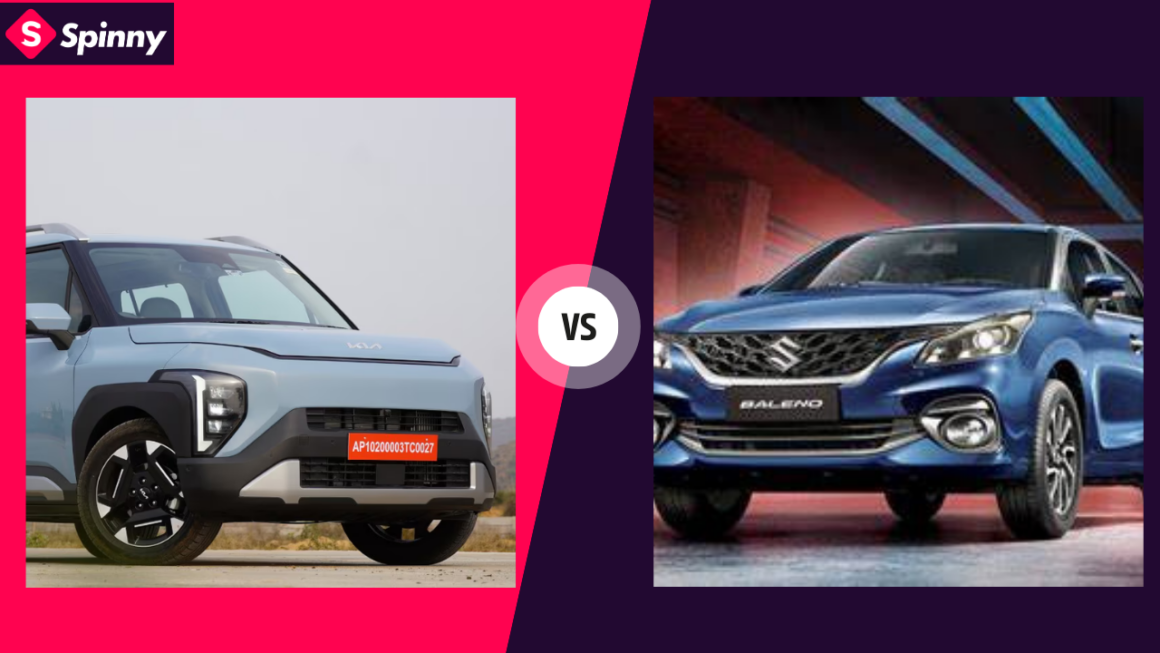
The compact SUV segment is not just one of the most popular segments in the Indian automotive industry, but also a sweet spot where affordability meets aspiration. Built to suit the city-bred approach, the segment offers a package that blends the compact approach of a hatchback with the practical advantage of owning an SUV. As a result, compact SUVS often lock horns with premium hatchbacks, giving consumers a tough time choosing between the two. And since both segments are full of capable options that people can instantly connect with, cross-segment comparisons are inevitable in the journey of bringing home a new car. In this article, we bring to you one such cross-segment comparison between the latest entrant of the compact SUV segment, Kia Syros and one of the most iconic premium hatchbacks, the Maruti Suzuki Baleno. Pitched as value-oriented offerings of their respective segments, here is how both cars do when put head-on against one another:
Kia Syros vs Maruti Suzuki Baleno: Dimensions
| Car | Kia Syros | Maruti Suzuki Baleno |
| Length | 3995 mm | 3990 mm |
| Width | 1805 mm | 1745 mm |
| Height | 1680 mm | 1500 mm |
| Wheelbase | 2550 mm | 2520 mm |
| Boot Space | 390 to 465 litres | 318 litres |
| Ground Clearance | 190 mm | 170 mm |
When it comes to dimensions, the head-on comparison above makes it evident that this is going to be an exciting cross-segment comparison. Talking about the looks at first, the Kia Syros offers a modern and rather distinct SUV design language that is a blend of boxy elements with a few contemporary touches. The overall look of the Syros hints at an assertive road presence with a hint of grandeur that goes well with the SUV’s premium touch. Design elements such as ice-cube LED headlamps, new age crystal-cut alloy wheels, and Kia’s signature tiger grille give the Syros a polarising yet creative look. When compared with the Baleno, the Syros shines, with a stance that’s 5 mm longer, 60 mm wider and 180 mm higher, with an additional 30 mm of wheelbase on offer. While the extra height helps the Syros offer a commanding view of the road ahead, the additional width and wheelbase work wonders for the SUV, making it offer a substantially larger boot of up to 465 litres, despite being only 5 mm longer in terms of overall length.
Coming to the Maruti Suzuki Baleno, the premium hatchback offers an assertive, sporty and elegant look that carries forward the Baleno’s classic silhouette with a new-age touch. The Baleno in its current generation offers an overall look that makes the hatchback look balanced, bold and truly alluring. Despite being narrower and shorter than the Syros, the Baleno offers a more proportional stance with a look that is less polarised and soothing to the eyes. Other than that, the Baleno also offers a spacious and practical cabin with ample boot space of up to 318 litres, which is decent enough for your luggage needs, but not as large as what the Syros offers.
Overall, when compared head-on, both cars offer a modern look that truly elevates their city-bred compact dimensions. While the final choice is rather subjective, in terms of on-paper dimensions, the Syros takes the lead with a wider and higher stance, along with a longer wheelbase and a much larger boot.
Overall winner: Syros for its overall practicality, cabin comfort and on-board space. However, with that said, if you happen to drive in highly congested areas, the Baleno offers much less fuss due to its more compact bodyline.
Kia Syros vs. Maruti Suzuki Baleno: Engine and Transmission
| New Kia Syros v Maruti Suzuki Baleno: Engine Comparison (Petrol) | ||||||||
| Cars | Kia Syros | Maruti Suzuki Baleno | ||||||
| Engine | 1.0-litre Turbocharged Petrol Engine | 1.2-litre Naturally Aspirated Petrol Engine | ||||||
| Power | 120 PS | 89.7 PS | ||||||
| Torque | 172 NM | 113 NM | ||||||
| Transmission (Manual) | 6-Speed Manual | 5-Speed Manual | ||||||
| Transmission (Automatic) | 7-Speed DCT | 5-Speed AMT | ||||||
| Mileage | 18.2 km/l (Manual) 17.68 km/l (Automatic) | 22.35 km/l (Manual) 22.94 km/l (Automatic | ||||||
One look at the engine comparison above and you’ll realise that there is a stark difference between the two segment runners. In terms of the engine on offer, while the Kia Syros offers a 1.0-litre turbocharged petrol engine on offer, the Baleno, on the other hand, offers a bigger 1.2-litre naturally aspirated petrol engine.
Comparing the two, the Turbocharged petrol engine offered with the Kia Syros offers a much peppier, power-packed and torque-rich engine with 30 PS of additional power and 59 NM of additional torque. Being a turbocharged unit, the engine offers exhilarating driving dynamics and an ample punch of power when needed. In addition to the 6-speed manual, the engine also offers a 7-speed DCT automatic onboard, which offers one of the best driving experiences in the segment. In terms of mileage as well, the Syros impresses with up to 18.2 km/l offered with the manual and up to 17.68 km/l with the DCT automatic.
Coming to the Baleno, the 1.2-litre K-Series Dual Jet engine comes forth as a well-refined engine that offers great linear power and impressive drivability. Being a naturally aspirated unit, you do get a decent punch of power and ample torque, but the overall performance isn’t as peppy as you get with a turbocharged unit. Transmission-wise, the engine offers either a 5-speed manual or a 5-speed AMT automatic, which is standard basics for almost every model these days. However, the USP of the Baleno’s engine is its top-notch mileage, which is as high as 22.94 km/l even with the automatic transmission.
Overall, when considering the petrol versions of both SUVS, the turbocharged engine of the Syros is a straight-up winner, with better power and torque figures along with a much advanced and exciting DCT automatic and great mileage. However, if you are someone who does not crave an extra oomph of power and desire a car that offers top-notch mileage across both city and highway runs, then the Baleno’s value quotient might impress you. Moreover, since the Baleno also comes with CNG onboard, the hatchback is the obvious choice for those who prefer the alternative fuel.
Overall Winner: Kia Syros for its exciting and power-packed performance, along with DCT automatic and impressive mileage.
| Kia Syros v Maruti Suzuki Baleno: Engine Comparison (Diesel) | ||||||||
| Cars | Kia Syros | Maruti Suzuki Baleno | ||||||
| Engine | 1.5-litre Turbo Diesel Engine | N/A | ||||||
| Power | 116 PS | N/A | ||||||
| Torque | 250 NM | N/A | ||||||
| Transmission (Manual) | 6-Speed Manual | N/A | ||||||
| Transmission (Automatic) | 6-Speed AMT | N/A | ||||||
| Mileage | 20.6 km/l (Manual) and 17.65 km/l (Automatic) | N/A | ||||||
The Diesel game is an area where the Syros single-handedly rules, with its 1.5-litre turbocharged diesel engine that comes mated with a 6-speed manual or AMT automatic. The engine itself is a rather impressive unit that offers good power and torque figures with great output across the RPM spectrum. Mileage on offer is also impressive, with the manual transmission offering up to 20.6 km/l.
As for the Baleno, the lack of a diesel engine is a factor that drives several buyers away from the premium hatchback, towards competitors like the Hyundai i20 and the Tata Altroz that continue to offer capable diesel engines despite stringent emission norms.
Overall Winner: Kia Syros
Kia Syros vs. Maruti Suzuki Baleno: Features and Comfort
| Kia Syros | Maruti Suzuki Baleno | |
| Infotainment system | 12.3-inch touch infotainment system with Android Auto and Apple CarPlay | 9-inch touch infotainment system with Android Auto and Apple CarPlay |
| Instrument Cluster | 12.3-inch Digital Instrument Cluster | Analogue Instrument Cluster with TFT MID |
| Music System | 8 Speaker Premium Harman Kardon Audio Setup | 4 Speaker Audio Setup with ARKAMYS |
| Climate Control | Yes, Dual Zone with a 5-inch AC control touch screen | Yes |
| Sunroof | Dual Pane Panoramic Sunroof | No |
| Ambient Lighting | Yes | Yes |
| Front Ventilated Seats | Yes | No |
| Rear Ventilated Seats | Yes (Seat Only) | No |
| Adjustable Seats | Yes, 4-Way Powered Driver’s Seat | Yes, manual driver’s seat adjustment |
| Rear AC Vents | Yes | Yes |
| Cruise Control | Yes | Yes |
| Wireless Charger | Yes | Yes |
| 360-Degree Camera | Yes | Yes |
| Connected Car Tech | Yes | Yes |
| ADAS | Level-2 | No |
One look at the comparison above and one would realise that the Kia Syros again offers an ultimate edge over the Maruti Suzuki Baleno in almost every aspect. When pitched head-on, the Kia Syros, being the latest offering, comes with several additional features that the Maruti Suzuki Baleno seems to miss out on.
These include features such as:
- A bigger 12.3-inch touch infotainment system
- A 12.3-inch digital MID cluster
- Dual-Pane Panoramic sunroof
- Premium Harman Kardon Speaker Setup
- Dual Zone Climate Control
- 5-inch Touch Control Panel for AC
- LEVEL-2 ADAS
- Front Ventilated Seats
- Rear Ventilated Seat
- Segment First Rear Reclining and Sliding Seats
Overall, the feature game is another area where the Kia Syros takes the lead with its large panoramic sunroof, LEVEL-2 ADAS, dual-zone climate control, etc.
Overall Winner: Kia Syros
Kia Syros vs. Maruti Suzuki Baleno: Safety Features
| Kia Syros | Maruti Suzuki Baleno | |
| Airbags | 6 as standard | 2 as standard, up to 6 |
| ABS with EBD | Yes | Yes |
| ESC | Yes | Yes |
| Hill Assist | Yes | Yes |
| TPMS | Yes | No |
| Rear Parking Sensor | Yes | Yes |
| Front Parking Sensors | Yes | No |
| All 4 Disc Brakes | Yes | No |
| Dual-Camera Dashcam | Yes | No |
| Level-2 ADAS | Yes | No |
When it comes to safety, while there is no doubt that the Maruti Suzuki Baleno has come a long way, it is still shocking that it fails to offer essential safety features such as 6-airbags standard across all trims. On the other hand, the Kia Syros does way more than just offering 6-airbags as standard and offers several additional safety features such as:
- Smart Cruise Control with Stop and Go
- Forward Collision Warning for Junction Turning and Direct Oncoming
- Side Parking Sensors
- Parking Collision Avoidance Assistance
- Reverse Assistance
- 4 Front and Rear Parking Sensors
- Dual Camera Dashcam
- TPMS
- Front Parking Sensors
- All 4 Disc Brakes
Thus, when compared head-on, the all-new Kia Syros seems a bit better thanks to the latest and greatest Level-2 ADAS on board.
Kia Syros vs Maruti Suzuki Baleno: Price Comparison
| Variant | Kia Syros Price Ex-Showroom | Maruti Suzuki BalenoPrice Ex-Showroom |
| Base Variant | Rs. 9 Lakh | Rs. 6.70 Lakh |
| Mid Variant | Rs. 11.50 – 12.80 Lakh | Rs. 7.54 – 8.44 Lakh |
| Upper Mid Variant | Rs. 13.30 – 14.60 Lakh | Rs. 8.47 – 9.37 Lakh |
| Top Variant | Rs. 16 – 17.80 Lakh | Rs. 9.42 – 9.92 Lakh |
When it comes to the price comparison, the Kia Syros comes with a six-trim lineup that includes HTK, HTK(O), HTK+, HTX, HTX+ and HTX(O). The trims are spread across 13 variants. On the other hand, Maruti Suzuki Baleno’s variant lineup is spread across four trims, including the Sigma, Delta, Zeta and Alpha, which are spread across 9 variants.
Coming to the price war, while the comparison above does make it clear that for those on a budget, the Baleno is a great pick that can be had in its top-end glory for a price of Rs. 9.92 Lakh, the Syros on the other hand is indeed an aggressively priced compact SUV that offers immense value for its segment and a slight increase of budget can go a long way when the Syros is chosen. That is because the Syros is a better loaded package across the trim lineup, as compared to the Maruti Suzuki Baleno, which offers a balanced list of features only on the upper mid and top-end trims.
Therefore, in terms of overall value, the Syros does offer better value for the money you will spend at each variant spectrum. Talking about the base trims of the Kia Syros, if you happen to let go of the Baleno’s upper mid-trim that is similarl priced, you still get features such as a 12.3-inch touch infotainment system with wireless Android Auto, Apple CarPlay, in addition to remote key, 4-speakers, 6-airbags, TPMS and auto light control, etc; all of which are features that the Baleno misses out on.
Similar is the story across the trim lineup, where the Kia Syros tends to offer a lot more for a lot less. The top-trim that is about 6 to 7.8 Lakh dearer than the Baleno is where the Syros goes all in to offer much more advanced features such as a better 8-speaker sound system, LEVEL-2 ADAS, dual zone climate control, 5-inch touch control AC panel, rear Ventilated Seat and segment first rear reclining and sliding seats, that justifies the jump considering that the Syros is also more spacious and practical.
Thus, as far as price is concerned, both the Kia Syros and the Baleno are similarly value for money in their respective segments. But considering all the aspects, the new Kia Syros is undoubtedly a better value offering with more space and better features onboard.
Kia Syros vs. Maruti Suzuki Baleno: Summary
Be it the Kia Syros or the Maruti Suzuki Baleno, both cars offer a value-oriented package that makes them a popular product in their respective segments. With looks that are contemporary, sporty and elegant, both the Baleno as well as the Kia Syros come forth as good-looking vehicles, with the Syros adopting a more polarising avatar. Coming to performance and engine, despite both cars offering a single petrol engine onboard, the Syros offers the advantage of driving a power-packed and exciting turbocharged unit with a thrilling DCT automatic onboard, while the Baleno offers an efficient naturally aspirated unit with AMT automatic and linear performance. The Syros also shines with its punchy diesel engine that the Baleno misses out on. Feature game is again an area where Syros takes the lead, being the latest offering with some additional goodies up its sleeve. Safety-wise, both cars do well, however, it is again the Syros that truly shines, with almost all modern-day safety tech onboard, including Level-2 ADAS. Finally, coming on to the price, while the Maruti Suzuki Baleno is indeed value for money, the Syros still manages to take the lead, across all variant spectrums.
FAQs
Q. Which of the two – Kia Syros or Maruti Suzuki Baleno – is larger?
The Kia Syros is larger than the Maruti Suzuki Baleno with a wider, taller stance, longer wheelbase, and bigger boot space.
Q. Which of the two – Kia Syros or Maruti Suzuki Baleno – offers better engine performance?
The Kia Syros offers a more power-packed and torque-rich turbo petrol engine with an optional DCT automatic onboard as well. The engine is much more receptive and peppier than the Naturally Aspirated engine offered by the Baleno.
Q. Which of the two – Kia Syros or Maruti Suzuki Baleno – has more advanced features?
The Kia Syros includes advanced features like a dual-pane panoramic sunroof, dual-zone climate control, a 5-inch touch control AC panel, rear Ventilated Seat, segment-first rear reclining and sliding seats and Level 2 ADAS, all of which the Maruti Suzuki Baleno lacks.
Q. Which of the two – Kia Syros or Maruti Suzuki Baleno – offers better value for money?
The Kia Syros offers better value for money across the entire trim lineup compared to the Maruti Suzuki Baleno, thanks to it being more spacious and feature-rich.
Q. Which of the two – Kia Syros or Maruti Suzuki Baleno – is safer?
The Kia Syros can be considered safer since it offers several advanced safety features such as Level-2 ADAS, TPMS, all disc brakes, 6-airbags as etc,. Which the Baleno lacks.