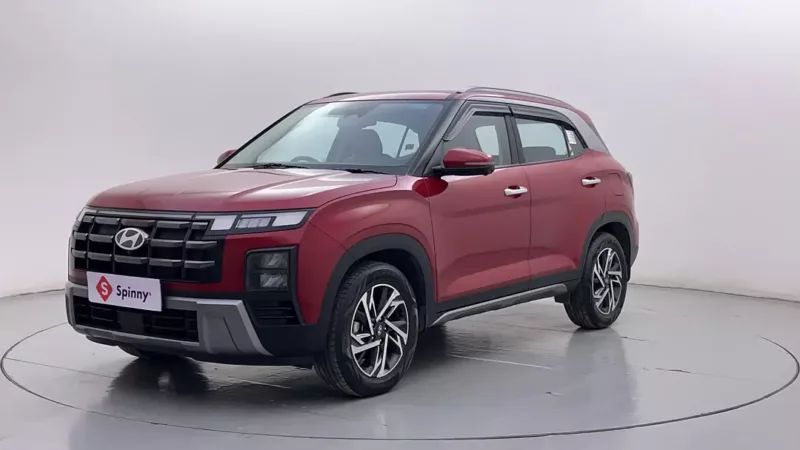

The sub 4 metre SUV segment is saturated with options, with each car offering something different from the other. Yet, Kia has gone ahead and launched the Syros in a segment where they already sell one other SUV. Not just that, another Korean SUV, the Hyundai Venue is also present in the segment and makes a great case for your attention.
There is no hiding from the fact that the Kia Syros has taken a bold approach and is looking to snatch the Hyundai Venue’s lunch money. But, will the Venue simply roll over and play dead, or is it still packing enough artillery to take the fight to the Syros? To find out the answer to this question, we have put together this comparison which differentiates them based on their size, powertrain, features, safety quotient and their price.
Kia Syros vs Hyundai Venue: Dimensions
| Kia Syros | Hyundai Venue | |
| Length | 3995 mm | 3995 mm |
| Width | 1805 mm | 1770 mm |
| Height | 1680 mm | 1617 mm |
| Wheelbase | 2550 mm | 2500 mm |
| Boot space | 390 – 465 litres (sliding second row) | 350 litres |
| Ground clearance | 190 mm | 195 mm |
As mentioned earlier, the Kia Syros and Hyundai Venue are both sub 4 metre SUVs and are of a similar size. Both SUVs are of the same length, however, the Syros is slightly wider and taller. The Syros will be slightly more accommodating for three passengers in the second row, due to its wider cabin, however, the biggest ace is the difference in height over the Venue. The Syros has a tall boy design and taller passengers will find the additional headroom in the Kia SUV to their liking.
The Kia Syros also has a longer wheelbase than the Hyundai Venue, and coupled with the sliding second row, the Syros offers better leg room for second row passengers. The sliding second row also means that the Syros comes with variable boot space, depending upon the position of the sliding seat. Despite that, the Syros offers more boot space than the Venue. The Hyundai SUV strikes back with a marginally better ground clearance, however, it won’t make for a huge difference in the real world.
It’s safe to say that the Kia Syros has a major advantage over the Hyundai Venue when it comes to the dimensions of the two SUVs.
Kia Syros vs Hyundai Venue: Engine & Transmission
| Kia Syros | Hyundai Venue | |
| Engine options | 1.0 litre turbocharged petrol engine, 1.5 litre diesel engine | 1.2 litre petrol engine, 1.0 litre turbocharged petrol engine, 1.5 litre diesel engine |
| Transmission options | 6 speed MT, 7 speed DCT (petrol), 6 speed AT (diesel) | 5 speed MT (1.2 petrol), 6 speed manual (turbo petrol and diesel), 7 speed DCT (turbo petrol) |
| Power | 120 PS (petrol), 116 PS (diesel) | 83 PS (1.2 petrol), 120 PS (turbo petrol), 116 PS (diesel) |
| Torque | 172 Nm (petrol), 250 Nm (diesel) | 114 Nm (1.2 petrol), 172 Nm (turbo-petrol), 250 Nm (diesel) |
| Mileage | 17.65 kmpl to 20.75 kmpl | 18 kmpl to 25 kmpl |
The Kia Syros and Hyundai Venue are available with both petrol and diesel engine options. However, whereas the Kia SUV is available with one of each, the Venue offers a choice of two petrol and one diesel. The Venue instantly takes the lead as it offers a wider range of variety for new car buyers.
There isn’t much of a performance battle as well, as the Kia Syros and Hyundai Venue are offered with the same engine options which have a similar output. As for the one additional petrol engine offered with the Venue, it is a naturally aspirated engine and the power output is far lesser than the turbocharged petrol engine that is offered with both, the Syros and the Venue. This engine is better suited for those who have a moderate driving style and prefer an engine with a calm and linear power delivery.
The biggest difference between the two SUVs comes down to transmission choice. The turbocharged petrol engine in both SUVs gets the same 6 speed manual and 7 speed DCT choices. However, in case of the diesel engine, the Venue is only offered with a 6 manual transmission whereas the Syros gets a 6 speed automatic transmission option as well. The Syros’ mileage figures are also lower than the Venue’s.
The powertrain battle is a close one to call. The Venue offers more engine options whereas the Syros offers more transmission choices. Ultimately, it is the fuel efficiency which pulls it in favour of the Venue on paper, however, things will be closely matched in the real world.
Kia Syros vs Hyundai Venue: Features & Comfort
| Kia Syros | Hyundai Venue | |
| Infotainment system | 12.3 inch touchscreen | 8 inch touchscreen |
| Music system | 8 speaker Harman Karson system | 6 speaker system |
| Climate control | Automatic Climate Control | Automatic Climate Control |
| Ventilated seats | Front and Rear | No |
| Adjustable steering | Tilt adjustable | Tilt adjustable |
| Drive modes | Yes | Yes |
| Instrument cluster | 12.3 inch digital cluster | Digital cluster |
| Sunroof | Panoramic sunroof | Single pane sunroof |
| Adjustable seats | Electrically adjustable driver seat with manual seat height adjust | Electrically adjustable driver seat with manual seat height adjust |
| Rear AC vents | Yes | Yes |
| 60:40 split rear seat | Yes | Yes |
| Cruise control | Adaptive Cruise Control | Yes |
In today’s times, features have become an important consideration factor in the buying decision. That said, take one look at the brochure of the two cars and you will realise that the Kia Syros leaves teh Hyundai Venue rolling around in its dust. The Syros offers a larger touchscreen, a better digital instrument cluster, a premium sound system with more speakers, a panoramic sunroof and adaptive cruise control. Furthermore, what really strikes the final nail in the Venue’s coffin are the front and rear ventilated seats of the Syros.
That said, the Hyundai Venue isn’t exactly featureless. At one point of time, the Venue was the most handsomely equipped SUV in the segment. In fact, the Venue comes with a lot of features such as a touchscreen, an electric sunroof, automatic climate control, rear AC vents, which would be considered aspirational on any other sub 4 metre SUV. It’s only when it’s standing next to the Syros does the Venue feel like it has been starved of features. The one big miss on the Venue remains ventilated seats.
From the onset, the Kia Syros had such a big lead in the features department that it was going to be impossible for the Hyundai Venue to catch up. However, that said, the Venue offers most features that are useful and make driving a tad bit more fun, but it’s just that the Syros does it all a lot better and is the clear winner in the features battle.
Kia Syros vs Hyundai Venue: Safety Features
| Kia Syros | Hyundai Venue | |
| GNCAP safety rating | 5 stars from Bharat NCAP | Not tested |
| Airbags | 6 airbags | 6 airbags |
| ABS with EBD | Yes | Yes |
| ESC | Yes | Yes |
| Traction control | Yes | Yes |
| Automatic headlamps | Yes | Yes |
| Rain-sensing wipers | Yes | Yes |
| Hill-hold assist | Yes | Yes |
| Hill descent control | Not Available | Not Available |
| Rear sensors | Yes | Yes |
| Rear parking camera | Yes | Yes |
| ISOFIX child seat anchor points | Yes | Yes |
| ADAS | Yes | Yes |
On the safety front, the Kia Syros and Hyundai Venue are quite evenly matched in terms of features. Both cars come with six airbags, ESC, traction control, hill hold assist and even premium features like automatic headlamps, rain sensing wipers and a rear view camera. The Syros, however, has a slight advantage as it has been crash tested by Bharat NCAP and has a 5 star rating.
The Venue hasn’t been tested by Bharat NCAP or Global NCAP, the two crash testing agencies that test cars sold in India. The Venue did undergo a crash test by ANCAP (Australian NCAP) in 2019, in which it did secure a 4 star safety rating, however, those results cannot be taken into consideration as car makers often make structural changes to models sold outside India.
Both cars also feature ADAS (Advanced Driver Assistance Systems), but the Syros has a full blow Level 2 suite of ADAS features whereas the Hyundai Venue is equipped with a more basic Level 1 suite with lesser features and equipment.
While the Syros and Venue battle it out with almost the same safety tech onboard, it is the Syros which edges ahead with its crash test rating and a more advanced ADAS system.
Kia Syros vs Hyundai Venue: Price Comparison
| Kia Syros | Hyundai Venue | |
| Base Variant | Rs. 9 lakh to Rs. 11 lakh | Rs. 7.94 lakh to Rs. 8.32 lakh |
| Mid Variant | Rs. 11.50 lakh to Rs. 12.80 lakh | Rs. 9.28 lakh to Rs. 10.37 lakh |
| Upper Mid Variant | Rs. 13.30 lakh to Rs. 14.60 lakh | Rs. 10.80 lakh to Rs. 11.95 lakh |
| Top Variant | Rs. 16 lakh to Rs. 17.80 lakh | Rs. 12.53 lakh to Rs. 13.62 lakh |
One look at the price table and you will find that the Kia Syros is priced well above the Hyundai Venue, especially considering the fact that both SUVs are of a similar size, have similar powertrains, and ultimately exist in the same segment.
If we look at the base variants of both cars, the Syros is at least Rs, 68,000 more expensive and this number will only go up when you compare similar powertrains. However, the base variant of the Syros packs in a good number of features that the Venue simply can’t match. If you are looking at base variants of both SUVs, we recommend you go for the Kia Syros.
If you are considering the mid variants or upper mid variants of both SUVs, the Kia Syros once again makes a more compelling argument as it is offering a lot more features than the Hyundai Venue. For an additional Rs. 2 to 2.5 lakh, the features being offered on the Syros once again trump those of the Hyundai Venue.
The battle really heats up when we compare the top variants. The Kia Syros is demanding Rs. 3.5 lakh to Rs. 5 lakh more for its top variants in comparison to the Hyundai Venue. While the features offered in the top variants of the Syros are thoroughly premium, they don’t merit such a steep increase in the price. For a similar price, one can start looking at similarly specced SUVs in a segment above. Therefore, the Hyundai Venue is the smarter choice of the two SUVs in this battle of top variants.
The Kia Syros is playing the features card against the Hyundai Venue to justify its higher pricing. In case of the lower and mid variants, it is an acceptable trade off as the features on offer add great value for the driver and passengers. However, in the case of top variants, the additional features of the Kia Syros are more aspirational, but don’t really enhance practicality or utility, and thus don’t offer the same value for your money as the Hyundai Venue.
Summary
In summary, the Kia Syros offers a major advantage over the Hyundai Venue when you compare their dimensions and features. On the safety front, the Syros once again wins but by a much smaller margin and due to its more advanced ADAS and NCAP crash test rating. But then again, ADAS isn’t really helpful in 90 percent of Indian driving conditions. The Hyundai Venue actually has an advantage over the Kia Syros on the powertrain front.
Ultimately, the Hyundai Venue is a great SUV and will work perfectly for those on a strict budget. On the other hand, if you want an SUV that offers features that are found on larger SUVs, but in a compact avatar, then, the Kia Syros will be just right for you.
FAQs about Kia Syros vs Hyundai Venue
Q. What is the difference between Venue and Syros?
The Hyundai Venue and Kia Syros are both sub 4 metre SUVs and they are equipped with similar powertrains. However, the Kia Syros offers features that are usually found in cars a segment above. Therefore, the Syros is offering a feature loaded experience in a compact size.
Q. Is Kia Syros a safe car?
The Kia Syros is one of the safest sub-4 metre SUVs. It gets 6 airbags as standard, along with ESP, traction control, hill hold assist, ISOFIX mounting points and even Level 2 ADAS. Furthermore, the Kia Syros has also been crash tested by Bharat NCAP and it received a 5-star safety rating.
Q. Do Kia Syros and Hyundai Venue have the same engine?
The Kia Syros and Hyundai Venue feature the same 1.0-litre turbocharged petrol engine with a choice of 6 speed MT and a 7 speed DCT, and a 1.5-litre diesel engine with a 6 speed MT. The Kia Syros also gets a 6 speed AT with the diesel engine, not found on the Hyundai Venue. Lastly, the Hyundai Venue also gets a 1.2-litre naturally aspirated petrol engine with a 5 speed MT which is not available with the Kia Syros.
Q. Is Kia Syros available in India?
Yes, the Syros is a part of Kia’s India lineup.
Q. Which car has more airbags, Hyundai Venue or Kia Syros?
The Hyundai Venue and Kia Syros are available with 6 airbags each.
Q. Which car has ADAS, Hyundai Venue or Kia Syros?
The Hyundai Venue and Kia Suros are both equipped with ADAS. However, the Venue only has a Level 1 ADAS suite whereas the Kia Syros has a more advanced Level 2 ADAS suite.