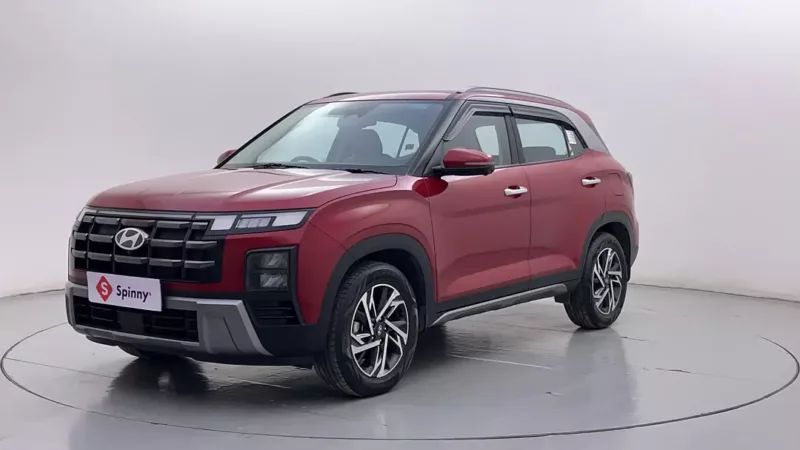

Seven-seater cars have gained significant popularity in India in recent years, and now there are many options in the market to explore. The latest one is the Kia Carens Clavis, which is a more premium version of the Kia Carens. With a great wealth of features, refined powertrains, and ample space and comfort for all occupants, the Carens Clavis is a compelling and affordable alternative to the Toyota Innova. However, the Carens Clavis itself has some alternatives too, and the Toyota Rumion is an appealing one of them. While the Rumion is not as advanced as the Clavis, it can comfortably offer everything an average Indian family expects of a 7-seater MUV. So, is it worth buying a Kia Carens Clavis, or can a Toyota Rumion be just what you need? To simplify things for you, in this article on Kia Carens Clavis vs Toyota Rumion, we compare the two and find out which one is better for your needs.
Kia Carens Clavis vs Toyota Rumion: Dimensions & Design
Kia Carens Clavis | Toyota Rumion | |
Length | 4550 mm | 4420 mm |
Width | 1800 mm | 1735 mm |
Height | 1708 mm | 1690 mm |
Wheelbase | 2780 mm | 2740 mm |
Boot Space | 216 litres | 209 litres |
Like its parent car, the Kia Carens, the Kia Carens Clavis is larger than the Toyota Rumion. In measurements, the Carens Clavis is 130 mm longer, 65 mm wider, 18 mm taller, and has a 40 mm longer wheelbase than the Toyota Rumion. If we solely focus on the wheelbase, the Carens Clavis has one of the longest wheelbases among the 7-seater cars in India; in fact, it is longer than that of even the Toyota Innova Crysta. Such a wheelbase, in addition to some extra width, makes the third row of the Carens Clavis substantially more spacious than the third row of the Rumion.
Coming to the looks, the Kia Carens looks more cutting-edge than the Toyota Rumion. While the Carens Clavis shares many design elements with the Kia Carens, it follows Kia’s latest design language that gives it a ‘digital tiger face.’ The front fascia is largely minimal with a concealed grille and thin LED DRLs that extend into a triangular housing for the LED headlamps. There is a contrasting black air intake lower down the bumper with a silver bash plate. From the side, the Clavis is nearly identical to the Kia Carens with the sloping roofline and sharp waistline that narrows at the front doors and flares out towards the rear and upswept quarter glasses. Nonetheless, there are completely new dual-tone 17-inch alloy wheels. At the rear, the star-shaped tail lamps and the light bar that connects them, again are largely like the Kia Carens.
On the other hand, the Toyota Rumion looks more traditional and much like the car is the rebadged version of – Maruti Ertiga. Its face features a broad honeycomb grille inspired by the Toyota Innova Hycross. Lower down, the bumper is a blacked-out air dam with a chromed hexagonal housing. The side profile is nearly identical to that of the Ertiga, with a prominent waistline and a floating roof effect created by the window line merging with the rear windscreen. The rear, too, is quite like that of the Ertiga, as the only differentiator is the badging.
The Kia Carens Clavis is larger and more futuristic-looking than the Toyota Rumion.
Kia Carens Clavis vs Toyota Rumion: Engine & Transmission
Kia Carens Clavis | Toyota Rumion | |
Engine | 1.5-litre petrol engine 1.5-litre turbo diesel engine 1.5-litre turbo petrol engine | 1.5-litre petrol engine |
Power | 115 PS 116 PS 160 PS | 103 PS 88 PS (CNG) |
Torque | 144 Nm 250 Nm 253 Nm | 137 Nm 121.5 Nm (CNG) |
Transmission | 6-speed manual transmission with all engines 6-speed iMT and 7-speed DCT automatic with the turbo petrol engine 6-speed torque converter automatic with the turbo diesel engine | 5-speed manual gearbox and 6-speed torque converter automatic with petrol-powered engine 5-speed manual gearbox with CNG variants |
Mileage | Up to 16.50 km/l (petrol) Up to 21.30 km/l (diesel) | Up to 20.51 km/l (petrol) Up to 26.11 km/kg (CNG) |
As can be seen, each of the engines offered with the Kia Carens Clavis is more powerful than the petrol engine offered with the Maruti Suzuki Ertiga. With more power, the Kia Carens Clavis offers more engine options to buyers. For heavy usage requirements, the Carens Clavis has a diesel engine. For an enthusiastic driver, the Carens Clavis has a turbo petrol engine. At the same time, for day-to-day driving requirements, its naturally aspirated petrol engine can deliver the required power. On the other hand, the Maruti Ertiga offers CNG models, which offer an exceptional mileage of up to 26.11 km/kg.
The Kia Carens Clavis offers three engine options: a 1.5-litre naturally aspirated petrol engine, a 1.5-litre turbo petrol engine, and a 1.5-litre turbo diesel engine. Each of these engines is more powerful than the 1.5-litre naturally aspirated petrol engine of the Toyota Rumion. For extensive usage, the diesel engine of the Clavis is a great pick. It has been in the market for a long time with the Hyundai Creta, Kia Seltos, and some other Korean cars. For someone who enjoys driving, the turbo petrol engine of the Carens Clavis is an appealing offering; it also powers the Creta, Seltos, Verna, and Alcazar and is known for its high-spirited performance. At the same time, for day-to-day driving requirements, its naturally aspirated petrol engine can comfortably meet the expectations.
On the other hand, the 1.5-litre naturally aspirated petrol engine of the Toyota Rumion has also spent a long time in the market with the Maruti Ertiga and earned a reputation for refinement, mileage, and reliability. A key advantage of the Rumion over the Carens Clavis is offering CNG models.
The Kia Carens Clavis is significantly more powerful than the Toyota Rumion and offers more engine and transmission combinations. Whereas the Toyota Rumion offers a considerable advantage with CNG-powered variants.
Kia Carens Clavis vs Toyota Rumion: Features & Comfort
Kia Carens Clavis | Toyota Rumion | |
Infotainment system | 12.25-inch touchscreen infotainment | 7-inch touchscreen infotainment system |
Music system | 8-speaker BOSE music system | 6-speaker Arkamys sound system |
Climate control | Automatic | Automatic |
Ventilated seats | Front ventilated seats | Not available |
Adjustable steering | Tilt & Telescopic | Tilt |
Drive modes | Eco, Normal, Sport | Not available |
Instrument cluster | 12.25-inch digital instrument cluster | 7-inch semi-digital instrument cluster |
Sunroof | Panoramic sunroof | Not available |
Adjustable seats (manual or electric) | 4-way powered driver seat | Height adjustable driver seat (manual) |
Rear AC vents | Available | Available |
60:40 rear seat split | 50:50 split for the third row | 50:50 split for the third row |
Cruise control | Available | Available |
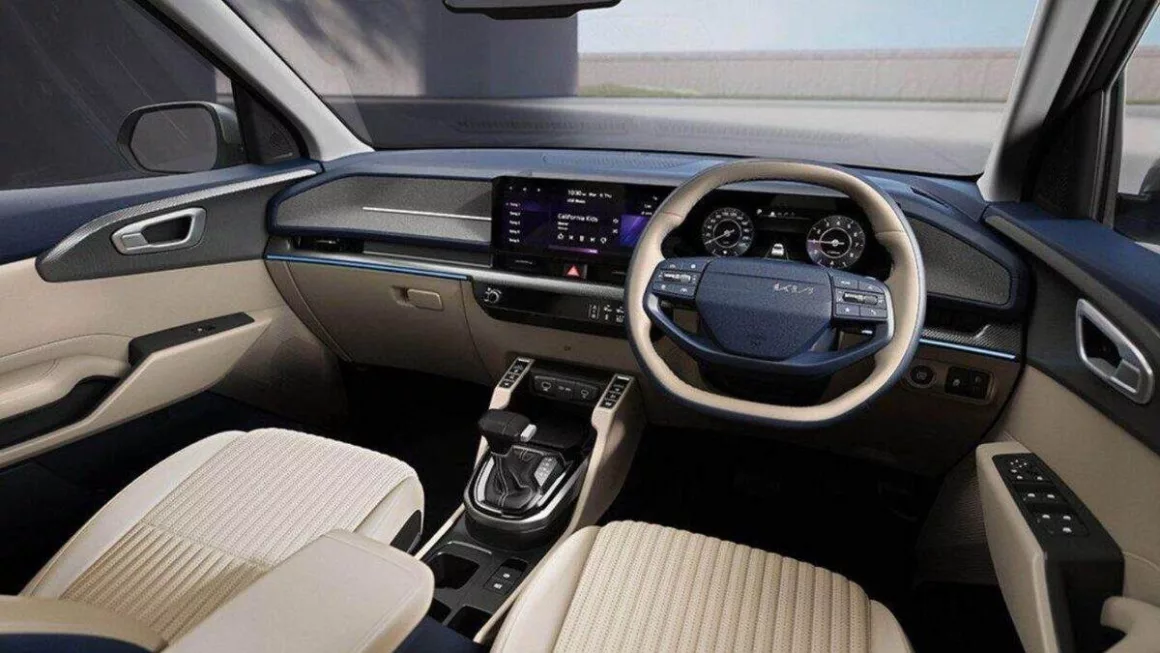
Like the exterior, the Kia Carens Clavis feels more modern and futuristic on the inside, compared to the Toyota Rumion. The Korean MUV has a clean, minimalist layout of interiors. On the edge of the clean dashboard, the Carens Clavis features a new dual-display setup as seen on the Kia Seltos. This set-up consists of a 12.25-inch digital instrument cluster and a 12.25-inch touchscreen infotainment system. The panels housing the door handles are of the same colour as the dashboard, creating a wraparound effect. Moreover, a stylish gear knob and a two-spoke squarish steering add to the modernity.
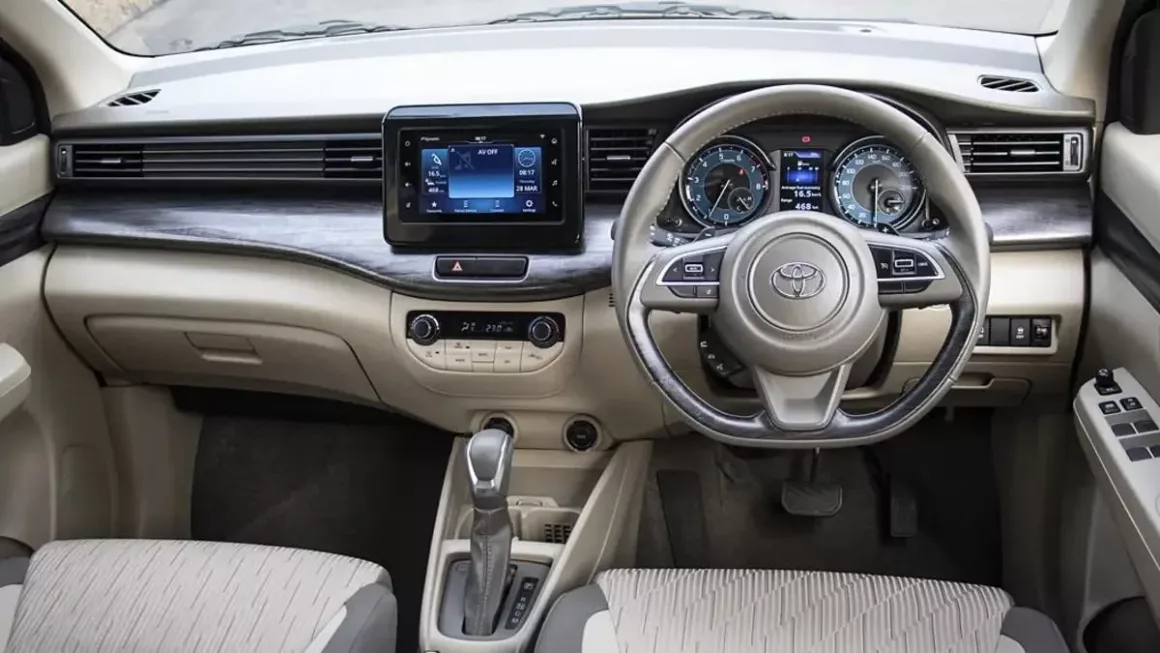
Meanwhile, the Toyota Rumion has the same interior layout as the Maruti Ertiga. The same layered dashboard features horizontally running stripes and a neatly propped touchscreen infotainment. With the wooden finish on the dashboard and light-coloured interior, the Rumion’s cabin feels premium enough, if not as futuristic as that of the Carens Clavis.
In terms of features, the Kia Carens Clavis and far richer than the Toyota Rumion. While the Rumion packs a satisfactory set of features, which includes automatic climate control with rood mounted vents, and cruise control, the Carens Clavis offers many more impressive technological perks such as a larger touchscreen, a better-sounding BOSE sound system, a panoramic sunroof, ventilated front seats, a wireless charger, and others.
The Kia Carens Clavis feels modern on the inside and packs more upmarket features compared to the Toyota Rumion.
Kia Carens Clavis vs Toyota Rumion: Safety Features
Kia Carens Clavis | Toyota Rumion | |
NCAP Safety Rating | Not tested | Not tested |
Airbags | Six airbags as standard | Up to four |
ABS with EBD | Yes | Yes |
ESC | Yes | Yes |
Traction Control | Yes | Yes |
Automatic headlamps | Yes | Yes |
Rain-sensing Wipers | Yes | No |
Hill hold assist | Yes | Yes |
Hill descent control | Yes | No |
Rear sensors | Yes | Yes |
Rear parking camera | 360-degree camera | Yes |
ISOFIX Child seat anchor points | Yes | Yes |
ADAS | Level-2 ADAS features | No |
Neither the Kia Carens Clavis nor the Toyota Rumion is tested by any NCAP. However, since the Kia Carens Clavis is based on the Kia Carens, which has scored a 3-star rating in the Global NCAP safety test, and the same is the rating of the Maruti Ertiga, which is structurally the same as the Toyota Rumion. So, a 3-star Global NCAP safety rating can be held true for both the Carens Clavis and Rumion. However, the Kia Carens Clavis packs more safety features than the Toyota Rumion.
The base variant of the Kia Carens Clavis, THE, features six airbags, ABS with EBD, ESC, vehicle stability management, hill-start assist, tyre pressure monitor, rear parking sensors, all-wheel disc brakes, ISOFIX child anchorages, and more. Meanwhile, its top variant offers the coveted Level-2 ADAS safety suite, which mitigates the possibility of accidents in the first place. This safety suite consists of Front Collision Warning, Front Collision Avoidance Assist, Lane Departure Warning, Lane Keep Assist, Lane Following Assist, High Beam Assist, Driver Attention Warning, Smart Cruise Control with Stop and Go, Leading Vehicle Departure Alert, Blind Spot Collision Warning and Avoidance Assist, Rear Cross Traffic Collision Warning and Avoidance Assist, Safe Exit Warning, 360 Degree Camera, Blind View Monitor in Cluster, and more.
Because of its extensive list of safety features, the Kia Carens Clavis is a safer MUV than the Toyota Rumion.
Kia Carens Clavis vs Toyota Rumion: Price comparison
Kia Carens Clavis | Toyota Rumion | |
Base variants (Ex-Showroom) | Rs 11.50 – 14.55 lakh | Rs. 10.54 – 12.04 lakhs |
Mid variants (Ex-Showroom) | Rs 13.50 – 18 lakh | Rs. 11.70 – 13.10 lakhs |
Upper mid variants (Ex-Showroom) | Rs 16.20 – 19.50 lakh | |
Top variant | Rs 19.40 – 21.50 lakh | Rs. 12.43 – 13.83 lakhs |
As far as prices are concerned, the Kia Carens Clavis is steeply pricier than the Toyota Rumion, especially in the higher variants. Speaking of variants, the Kia Carens Clavis is offered in seven variants – HTE, HTE(O), HTK, HTK+, HTK+(O), HTX and HTX+. These variants are further segregated based on powertrains. In comparison, the Toyota Rumion offers fewer variants with three main trims – S, G, and V. All the same, considering the value both these MUVs offer, both are equally valuable.
Kia Carens Clavis vs Toyota Rumion: Summary
In the price bracket of 10 to 15 lakh, the Toyota Rumion is a fantastic 7-seater MUV. It is loaded enough to deliver a premium ride experience, and offers a tried and trusted petrol engine that delivers commendable mileage. Moreover, the Rumion brings an invaluable durability and dependability that is generally associated with the brand name of Toyota.
All the same, if you frequently need to use the third row of your 7-seater MUV, the lower variants of the Carens Clavis should be a better choice, considering their price gap from the Rumion and the space it offers in the third row. In addition to that, if you want a richer experience for your family and are willing to stretch your budget, the Carens Clavis is obviously a better deal.
Kia Carens Clavis vs Toyota Rumion: FAQs
Among the Kia Carens Clavis and Toyota Rumion, which is larger?
Kia Carens Clavis is 4,550 mm long, 1,800 mm wide, 1,708 mm tall, and has a wheelbase of 2,780 mm. Toyota Rumion is 4,420 mm long, 1,735 mm wide, 1,690 mm tall, and has a wheelbase of 2,740 mm. Therefore, the Kia Carens Clavis is considerably larger than the Toyota Rumion.
Among the Kia Carens Clavis and Toyota Rumion, which car is more powerful?
The Kia Carens Clavis offers three engines: a 1.5-litre naturally aspirated petrol engine, which produces 115 PS power, a 1.5-litre turbo diesel engine, which produces 116 PS power, and a 1.5-litre turbo petrol engine, which produces 160 PS. At the same time, the 1.5-litre petrol engine of the Toyota Rumion produces 103 PS of power. Therefore, each of the engines of the Kia Carens Clavis is more powerful than the 1.5-litre petrol engine of the Toyota Rumion.
Among the Kia Carens Clavis and the Toyota Rumion, which has better sound quality?
The Kia Carens Clavis’s 8-speaker BOSE sound system offers a better and more premium music experience than the Toyota Rumion’s 6-speaker ARKAMYS system.
Which safety features are available in the base variant of the Kia Carens Clavis?
The safety features of the base HTE variant of the Kia Carens Clavis include six airbags, ABS with EBD, ESC, vehicle stability management, hill-start assist, tyre pressure monitor, rear parking sensors, all-wheel disc brakes, ISOFIX child anchorages, and more.
What types of automatic transmission systems are available in the Kia Carens Clavis and the Toyota Rumion?
The Toyota Rumion offers a 6-speed torque converter automatic. The Kia Carens Clavis offers a 6-speed torque converter automatic and a 7-speed DCT automatic.