BYD’s presence in India has grown substantially in recent years. Its new-age electric vehicles are redefining customer expectations for entry-level luxury cars. However, you might be surprised to know that the Chinese company has existed in India since 2008.
As a conglomerate, BYD’s portfolio goes beyond car manufacturing. It is also responsible for making electric trucks, buses, mass rail transit systems, and electronic components such as mobile phones. What makes BYD especially efficient is its vertical outlook towards selling cars and other products. The design and manufacturing of all components required for making them is done in house by the several companies that run under the BYD umbrella, the biggest of which is BYD Auto.
Brief History of BYD
The BYD conglomerate of China, as we know it today, was founded in 1995 to manufacture batteries. In its initial years, BYD focused on making battery manufacturing a human labour-intensive process, instead of the cutting edge machinery that was being used by notable manufacturers in Japan. Using the low labour costs in China to its advantage, BYD was able to manufacture batteries at a significant advantage.
BYD Auto
BYD constantly evolved and in 2003, it acquired Xi’an Qinchuan Automobile Co., Ltd., restructured it, and renamed it as BYD Auto. While BYD Auto is known for its EVs today, the Chinese automaker’s first car was the BYD F3 and it ran on petrol. Soon after in 2009, BYD unveiled its first fully electric car, the e6. Since then, the company has rapidly expanded into foreign markets and even manufactures cars at plants outside of China, like Thailand and Brazil.
BYD’s Entry in India
BYD entered the Indian market in 2007 and it had a running factory by 2008, manufacturing electronic components, majorly for smartphones. In 2016, BYD began supplying electric bus chassis and batteries to Olectra Greentech Ltd., thus marking its entry into the Indian automotive market.
In 2021, BYD stepped into the passenger vehicle market of India with the e6 MPV. Initially, the model was only sold on a B2B basis to fleet operators, however, it was soon made available for private buyers as well. While the e6 offered great space and a pleasant consumer experience as a taxi, it wasn’t specced well enough to be considered value for money by private buyers.
BYD’s first truly competitive offering for private car buyers was the Atto 3. It was launched in 2022 and was initially offered in a single fully loaded variant at Rs. 33.99 lakh (ex-showroom). It was well received by early adopters with BYD managing to secure more than 1500 bookings in a short span of time.
BYD Models on Sale in India
The Chinese car maker sells four car models in India, all of which are either CKD or CBU units. Despite only selling four models, BYD exists in the SUV, Sedan and Crossover segments.
1. BYD Atto 3

The Atto 3 is a compact electric SUV, similar in size to the Hyundai Creta. It is well equipped with features, and features a rather funky interior. It’s made of high quality material such as soft touch plastics and faux leather upholstery. On the performance front, the Atto 3 is quick and capable of sprinting from 0 to 100 kmph in 7.3 seconds. It can also be charged from 0 to 80 percent in 50 minutes using DC fast charging. The Atto 3 has a 5 star Euro NCAP safety rating and features safety features like 7 airbags, 360 degree camera and a Level 2 ADAS suite.
The BYD Atto 3, first launched in 2022, underwent an update in 2024. Previously, it was only offered in a single variant. However, the Chinese car maker taking advantage of its CKD nature introduced two new lower variants, significantly reducing the price of the entry level variant of the Atto 3. It achieved this primarily by introducing a smaller battery pack for the base variant and deleting some features from the base and mid spec variants.
| BYD Atto 3 Variant Wise Pricing | |
| Variant | Ex-showroom Price |
| Dynamic | Rs. 24.99 lakh |
| Premium | Rs. 29.85 lakh |
| Superior | Rs. 33.99 lakh |
2. BYD eMAX 7
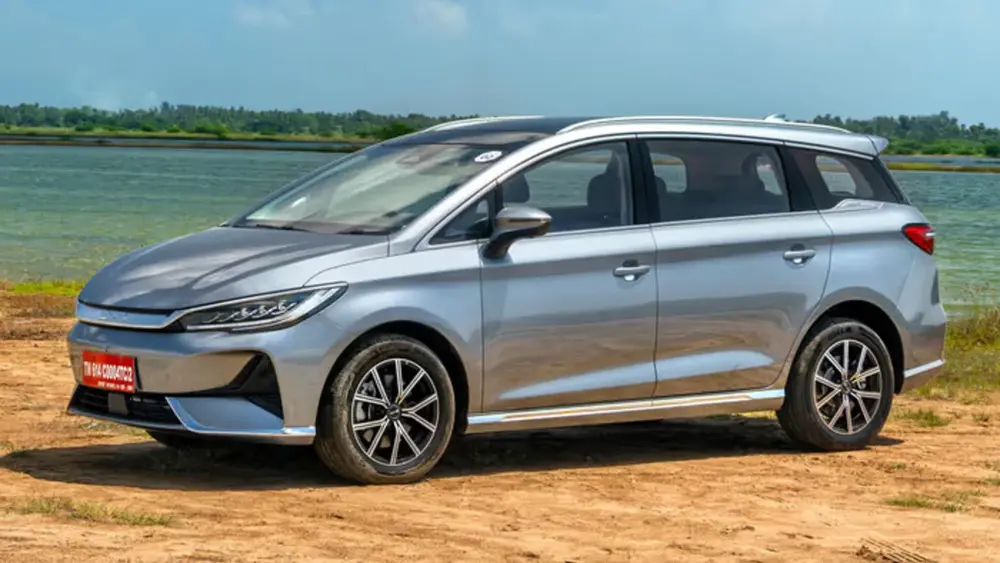
The eMAX 7 is available in 6- and 7-seater configurations and is also far better equipped than BYD’s first MPV, the e6. The eMAX 7 features an elegant cabin design, and while the design is conventional, it stands out due to the quality of materials. Though it is an MPV, the eMAX 7 is capable of going from 0 to 100 kmph in 8.6 seconds and can be charged from 0 to 80 percent in 37 minutes using a DC charger. The eMAX 7 features six airbags, 360-degree camera, ESP, and Level 2 ADAS among other safety features.
The eMAX 7 is seen as a replacement for the e6, which is no longer on sale in India. Unlike the e6 which was a five seater, the eMAX 7 is available in six and seven seater configurations. It is the six seater version which features captain seats, yet surprisingly it is the 7 seater version which is slightly more expensive.
| BYD eMax 7 Variant Wise Pricing | |
| Variant | Ex-showroom Price |
| Premium 6 Seater | Rs. 26.90 lakh |
| Premium 7 Seater | Rs. 27.50 lakh |
| Superior 6 Seater | Rs. 29.30 lakh |
| Superior 7 Seater | Rs. 29.90 lakh |
3. BYD Seal
The Seal was introduced in 2024 as a premium model that would serve as an entry level luxury sedan. Compared to the eMAX 7, the Seal features a highly evocative cabin design. The attention to detail in the design of even the smallest elements, such as the AC vents and gear selector lever, lend the Seal an air of superiority over lower BYD models. The Seal is quick too, with the Performance variant capable of a 0 to 100 time of 3.8 seconds. Its batteries can be charged from 0 to 80 percent in 45 minutes using DC power. The Seal is also equipped with 9 airbags, ESP, Level 2 ADAS and has a 5 star safety rating from Euro NCAP.
The BYD Seal, when it was first launched, was the most expensive BYD car to be launched in India. It showcased that BYD was also capable of making sporty sedans, a role it continues to play even after the Sealion 7 took over its crown of being the most expensive BYD car on sale in India. The Seal is available in three variants, all offering great value in one area or the other, and that is despite the Seal being a CBU offering.
| BYD Seal Variant Wise Pricing | |
| Variant | Ex-showroom Price |
| Dynamic | Rs. 41 lakh |
| Premium | Rs. 45.55 lakh |
| Performance | Rs. 53 lakh |
4. BYD Sealion 7
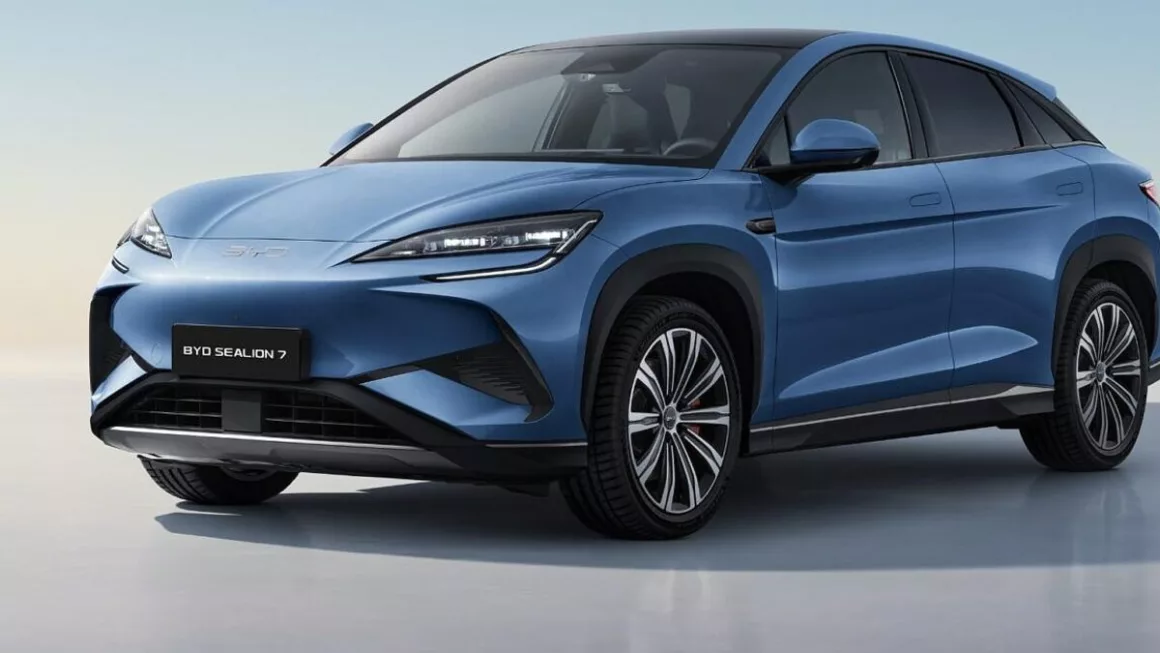
The Sealion 7 is a crossover SUV and has similar external aesthetics as the Seal. However, unlike the sedan, the Sealion 7 has a rather minimalist styling for its interior but it continues to feel thoroughly premium. The performance on offer is not minimal at all with the Sealion 7 capable of completing the 0 to 100 kmph run in 4.5 seconds. The battery can be topped up from 10 to 80 percent in just 24 minutes using a 230 kW DC charger, the quickest for any BYD car sold in India. The Sealion 7 is yet to be crash tested, however, it features 11 airbags, 360 degree camera, Level 2 ADAS and even Driver Fatigue Monitoring.
The BYD Sealion 7 is currently the most expensive model sold by the Chinese car maker in the Indian market. It is a CBU offering and is available in two variants. While both variants offer the same features and battery pack, one is offered in a RWD format whereas the other features AWD due to an additional electric motor on the front axle.
| BYD Sealion 7 Variant Wise Pricing | |
| Variant | Ex-showroom Price |
| Premium | Rs. 48.90 lakh |
| Performance | Rs. 53.90 lakh |
BYD’s Battery Business in India
As we already know, BYD began its journey as a battery manufacturer and the Chinese company has remained at the forefront in that field in its 35 years of existence. In fact, BYD’s EV batteries, also better known as Blade Batteries, have been at the core of their success in the automotive space. This has led to many car makers buying the battery for their EVs from BYD.
In India, the Maruti Suzuki e Vitara uses BYD’s Blade battery. Toyota, who has partnered with Maruti and helped develop the e Vitara, will also spawn its own SUV based on the platform, which too will use BYD’s Blade battery. Furthermore, Mahindra Electric also sources batteries for the XEV.09 and BE.06 from BYD. Lastly, BYD also sells electric buses to Olectra Greentech and they too are equipped with Blade batteries.
It’s not just Indian car makers that are lining up to buy BYD’s Blade batteries. Ford, GM (through licensing), Kia and Toyota (for its international models) are also sourcing batteries from the Chinese battery manufacturer.
What is the Blade battery?
While battery technology is complex, what is essential to know is that big battery packs use battery cells. These battery cells have the power to charge and discharge, thus acting as reservoirs of energy. The packaging of these battery cells inside a battery pack is crucial, and this is where the Blade battery has an advantage.
BYD’s Blade batteries feature battery cells which are thin and long, and can be inserted like a blade inside the battery pack. This form of packaging also increases the packaging efficiency of the cells by 50 percent. While the efficiency is certainly a strong point on its own, BYD’s Blade battery is also quite robust. According to BYD, the battery pack emitted no fire or smoke even after it was pierced with a nail.
The efficiency and safety of the BYD Blade batteries have been the core reasons of their popularity among other car makers.
BYD’s Strategy for India
It’s safe to say that BYD runs multiple businesses in India. The first is that of an electric component manufacturer. It’s been running efficiently since 2008. With more and more electronic manufacturing now shifting to Indian shores, BYD is positioned to expand its footprint in the market.
As far as BYD Auto or its passenger car division is concerned, the Chinese car maker has made an impressive start to its life in India. While BYD has been selling passenger cars in India only since 2021, it has managed to slowly and steadily increase the size of its lineup to four cars by 2025. This is despite the Chinese car maker seeing a substantial investment from its Chinese backers blocked due to government restrictions.
It has, nonetheless, continued an upward trajectory, with the core reason being its competitive pricing despite half its cars being CBU models and the other half being CKD. However, to become a serious challenger in the Indian market, BYD will have to start the local assembly of cars and introduce more of its mass market models in India.
Lastly, BYD’s battery business is also booming in India. Its Blade batteries are quickly becoming the go to option for many car makers and with the advent of EVs now imminent, BYD is only poised to benefit from this upward trajectory. The Chinese battery manufacturer is poised to reveal its upgraded Blade battery in 2025, which could fast track its dominance over the EV sector not only in India, but in global markets as well.
Summary of BYD’s Presence in India
Over the years, BYD has significantly expanded its presence in India. Starting from a components manufacturer in 2008, the Chinese company now assembles cars on Indian soil and is also engaged in selling battery packs to Indian car makers. There have been talks about setting up a dedicated car factory in India that would locally manufacture many of BYDs global models and compete with local car makers, however, nothing actionable has yet materialised. However, with BYD’s expertise in EV manufacturing and Indian government’s policies encouraging EV adoption, BYD’s expansion in India is certainly a given.
FAQs about BYD
Q. Are BYD cars available in India?
Yes, BYD sells four car models in India: eMAX 7, Atto 3, Seal and Sealion 7. The e MAX 7 and Atto 3 are locally assembled (CKD) whereas the Seal and Sealion 7 are imported as CBU.
Q. Does BYD have a plant in India?
BYD does run a manufacturing plant in Tamil Nadu. However, it is primarily an electronic component manufacturing facility. The BYD e MAX 7 and Atto 3 are locally assembled (CKD) at this plant.
Q. When did BYD launch in India?
BYD has been present in India since 2007. However, it started selling passenger vehicles in 2021, starting with the e6 MPV.
Q. What is the full form of BYD?
BYD stands for Build Your Dreams. However, this tagline wasn’t thought of at the time the company started using the three letters for their name, and is instead a backronym.
Q. How big is the BYD Company?
BYD is a substantially big company and is listed as the sixth largest car maker and the largest EV maker globally. The company has multiple plants inside its home country of China and in other countries as well.