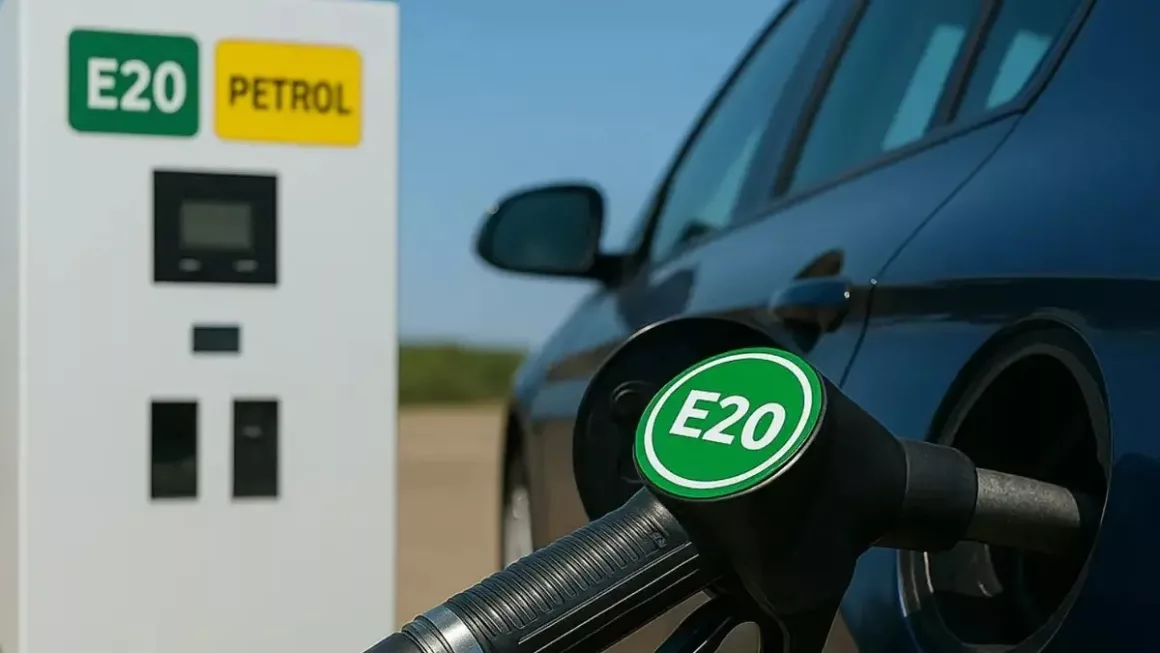
The Indian government has released a draft notification, proposing the introduction of higher ethanol-blended fuels, including E85 and E100. In April 2025, the E20 fuel was rolled out nationwide, and now the government is looking to further cut dependency on crude oil imports, which has become a major concern with the ongoing U.S.-Israel-Iran war. Let’s dive deeper into the subject and learn what E85 and E100 mean for our cars.
What is the E85, E100 notification
On their official website, the Ministry of Road Transport and Highways has released a draft notification, which includes provisions for E85 fuel (a blend of 85 percent ethanol in petrol) and E100, which will enable vehicles to run completely on ethanol. These draft amendments to the Central Motor Vehicles Rules are open for public comments for 30 days, after which the government will analyse the feedback and make the final decision.
The draft notification also proposes a new classification of the ethanol-blended fuel. For example, the petrol description will change from E10/E to E10/E20, while explicitly including E85 and E100 within the regulatory framework. Likewise, biodiesel references shall be updated from B10 to B100 (100 percent biodiesel). It also standardises emission-testing parameters and technical terminology, and proposes increasing the gross vehicle weight threshold from 3,000 kg to 3,500 kg in select vehicle categories. Moreover, the draft notification changes the hydrogen fuel classification from “Hydrogen + CN” to “Hydrogen + CNG”.
What it means for E20-compliant cars
The problem with ethanol is its tendency to attract moisture and its lower energy density than petrol. Increasing ethanol content in fuel reduces the engine’s life, power output, and mileage. Cars manufactured after April 2023 are compatible with E20 petrol (blend of 80 percent petrol and 20 percent ethanol. Thereby, their parts, including engines, are engineered to run efficiently on E20 petrol. However, petrol blended with over 20 percent ethanol will be harmful for E-20-compliant cars.
All the same, even if the E85 and E100 fuels are approved, their rollout will not take place overnight. Moreover, expectedly, E20, E85, and E100 fuel will be sold side by side.
Moreover, for E85 and E100 fuel, manufacturers will have to re-engineer many components of their cars, including engines.
What it means for non-E20-compliant cars
While using E20 fuel in a non-E20-compliant car does not suddenly break it down, it gradually degrades the fuel system and corrodes certain metal components.
According to many complaints, non-E20-compliant car owners are already dealing with the problems being caused by the E20 fuel – reduced power delivery and mileage.
E85 and E100 fuels can cause many non-E20-compliant car owners to stop using their cars, as they will either not run on such high ethanol blends or will suffer major faults that are next to impossible to deal with. All the same, as mentioned before, expectedly, E20, E85, and E100 fuel will be sold side by side, and car owners will have the option of E20 fuel, which is much less harmful to a non-E20-compliant car than E85 fuel and E100 fuel.
FAQs
What is ethanol-blended fuel?
Basically, ethanol is ethyl alcohol. Composed of carbon, hydrogen, and oxygen atoms, ethanol is a type of alcohol commonly used in various applications, such as industrial solvents, beverages, and antiseptics. A key usage of ethanol is to be used as a biofuel, which is blended with petrol or gasoline, because it burns cleaner than other hydrocarbon-based fuels. The percentage of ethanol blended is denoted by a number following the letter ‘E,’ for example, E10, which means the solution of 10 percent ethanol and 90 percent petrol.
What is E20 petrol?
E20 petrol is a solution of 80 percent petrol and 20 percent ethanol. Ethanol is a biofuel usually produced by crops rich in sugars or starches such as corn, sugarcane, barley, wheat, and sorghum. India moved from E5 in 2003 to E10 by 2022. Initially, E20 was targeted to be rolled out by 2030; however, the government rolled out E20 in April 2025.
When will the government roll out the E85 and E100 fuels?
As of now, the Indian government has proposed E85 and E100 fuels via a draft notification on the website of the Ministry of Road Transport and Highways. This draft notification is open for public feedback for 30 days, after which the government will analyse the feedback and make the final decision.
Will E85 or E100 fuels harm my car?
Cars compatible with E20 fuel will be severely harmed if they are fuelled with petrol with ethanol content as high as 85 percent or 100 percent. Ethanol has a tendency to attract moisture, and it has lower energy density than petrol. Therefore, it accelerates wear and tear on certain components and causes corrosion.