

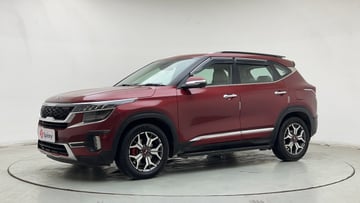

Tata’s new Harrier EV has landed smack in the middle of the Rs. 20 lakh to 30 lakh price bracket which has become a hotspot for modern Indian SUVs in recent years. There are many cars in its sights, however, one of them is the Safari which itself comes from the umbrella of Tata Motors. The three row SUV which is an ICE model featuring a diesel engine, finds itself in the crosshairs of its own electric cousin.
At first, comparing the Harrier EV against the Safari might seem a little bit odd due to the disparity in their powertrain. However, when you look at their size, price and features, one does end up comparing both cars as they are so close together on those fronts. The fact that Tata has been able to price the Harrier EV so aggressively is also dependent on the fact that the current price of the electric SUV is ‘introductory’ in nature, and will be increased in the future.
It then becomes doubly important to find out whether you should opt for the Tata Harrier EV, or are instead better off taking home the Tata Safari? To answer this question, we take a look at their dimensions, powertrain, features, safety tech and price to find out which of the two will work out better for you.
Table of Contents
Tata Harrier EV vs Tata Safari: Dimensions

When it comes to size, the Harrier EV and Tata Safari both have their own advantages and disadvantages, making it difficult to choose between them based on the dimensions.
| Tata Harrier EV | Tata Safari | |
| Length | 4607 mm | 4668 mm |
| Width | 2132 mm (ORVMs open) | 1922 mm (without ORVMs) |
| Height | 1740 mm | 1795 mm |
| Wheelbase | 2741 mm | 2741 mm |
| Boot space | 502 litres | 420 litres (third row folded) |
| Ground clearance | More than 200 mm | 205 mm |
The Tata Safari is the longer car and the primary reason for it are the three rows of the SUV. While it is built on the OMEGA ARC platform, that also underpins the diesel Harrier, the Harrier EV is built on a different platform called acti.ev by Tata Motors and is pronounced as active. The Harrier EV appears to be the wider car, however, Tata Motors has used different conventions to denote the width of its cars on its official channels.
In the case of the Safari, the width of the car is measured without the ORVMs whereas the Harrier EV’s width has been measured with the ORVMs open. However, both cars offer a large amounts of shoulder room inside the cabin with three passengers being able to sit quite comfortably in the second row of both cars.
The Safari is taller and this has largely been done to offer more head space for passengers in the third row. The Harrier EV does not have this problem as it is only a two row SUV. Despite being built on different platforms, the Harrier EV and the Safari have the same wheelbase. It is indicative of the fact that if we only look at the first two rows, passengers will find both cars to be equally comfortable.
When it comes to boot space, the Harrier EV is rated at 502 litres. It also has a frunk which offers 67 litres or 35 litres of cargo space, depending upon whether it is a RWD (rear-wheel drive) or AWD (all-wheel drive) configuration. Tata hasn’t officially disclosed the boot space volume for the Safari with all three rows up, however, the leftover space is enough for only two or three backpacks. With the third row folded down, the Safari’s boot space expands to 420 litres. The ground clearance of the Harrier EV has not yet been revealed but it is expected to be above 200 mm, and the Safari stands at 205 mm. There is no major difference here.
Ultimately, it is the Harrier EV that offers better practicality for 5 passengers as it offers more storage space, however, the Safari is more versatile as it can seat up to 7 passengers and with the third row folded down, it can liberate a lot of boot space.
Tata Harrier EV vs Tata Safari: Engine & Transmission

The Harrier EV and Safari both feature completely different powertrain technology, however, their performance numbers overlap.
| Tata Harrier EV | Tata Safari | |
| Engine options | Single Electric Motor, Dual Electric Motor | 2.0 litre diesel engine |
| Transmission options | Automatic | 6 speed MT, 6 speed AT |
| Power | 238 PS (RWD), 396 PS (AWD) | 170 PS |
| Torque | 315 Nm (RWD), 504 Nm (AWD) | 350 Nm |
| Mileage | 538 km to 627 km (Range) | 16.3 km/l (MT), 14.1 km/l (AT) |
The Harrier EV is sold in two different configurations. Tata offers a choice between single and dual motor configurations. The electric motor is placed on the rear axle (RWD) in the single motor configuration, and an additional motor is placed on the front axle for the dual motor configuration, making it AWD. Being an EV, it only has an automatic transmission. On the other hand, the Tata Safari is offered with a single option of a 2.0 litre diesel engine that can only send power to the front wheels. However, buyers have the choice to opt for either a manual or an automatic transmission.
The performance battle is squarely won the by the AWD Harrier EV as its total power output is more than double of the Safari’s diesel engine, and the torque figure too is significantly higher. The Safari continues to lose on the horsepower front when we compare it with the RWD Harrier EV, however, the diesel engine does make more torque than it.
While the efficiency figures aren’t out yet for the Harrier EV, it does boast of an ARAI certified range of 538 km for a smaller 65 kWh battery pack. A larger 75 kWh battery pack offers an ARAI certified range of 627 km and 622 km for the RWD and AWD versions, respectively. In the real world, the Harrier EV is expected to have a range of 370 km to 400 km for the smaller battery pack and 450 km to 480 km for the larger battery pack. In contrast, the Safari’s diesel engine has a healthy fuel efficiency of 14.1 km/l to 16.3 km/l, as certified by ARAI.
For anyone who prioritises outright performance, the Harrier EV will trump the Safari because of its electric nature. However, the Safari too continues to hold its own, and anyone looking for an engaging driving experience will find the diesel engine of the three row SUV to offer great potential.
Tata Harrier EV vs Tata Safari: Features & Comfort
Tata cars have been setting benchmarks on the features front in recent years, and both the Harrier EV and Safari offer a highly premium and comfortable experience.
| Tata Harrier EV | Tata Safari | |
| Infotainment system | 14.5 inch toucshcreen by HARMAN | 12.3 inch touchscreem by HARMAN |
| Music system | 10 speaker JBL sound system with Dolby Atmos | 10 speaker JBL sound system |
| Climate control | Dual Zone Climate Climate | Dual Zone Climate Control |
| Ventilated seats | Yes | Front and Rear |
| Adjustable steering | Tilt & Telescopic Adjustment | Tilt & Telescopic Adjustment |
| Drive modes | Yes | Yes |
| Instrument cluster | 10.25 inch digital instrument cluster | 10.25 inch digital instrument cluster |
| Sunroof | Panoramic sunroof | Panoramic sunroof |
| Adjustable seats | 6 way electrically adjustable driver seat with three memory positions, 4 way elecrically adjustable passenger seat | 6 way electrically adjustable driver seat with three memory positions, 4 way elecrically adjustable passenger seat |
| Rear AC vents | Yes (intergrated into B pillar) | Yes |
| 60:40 split rear seat | Yes | Yes |
| Cruise control | Adaptive Cruise Control | Adaptive Cruise Control |
The Harrier EV and Safari are both equipped with a suite of modern features that include a large touchscreen, 10 speaker JBL sound system, Dual Zone Climate Control, drive modes, 10.25 inch digital instrument cluster, ventilated seats, panoramic sunroof, tilt & telescopic adjustment for the steering wheel, electrically adjustable driver and passenger seats, rear AC cents, 60:40 split rear seats and even Adaptive Cruise Control.
That said, the Harrier EV features a larger 14.5 inch touchscreen compared to the 12.3 inch touchscreen of the Safari. Furthermore, the Harrier EV’s touchscreen is a Samsung Neo QLED display that is supposed to set benchmarks in the segment with its quality. The sound system of the Harrier EV also feature Dolby Atmos technology which offers a better surround sound experience. However, the Safari also has an ace up its sleeve. It offers ventilated seats for both front and second row passengers, a feature absent on the Harrier EV.
The Harrier EV also features a suit of cameras which not only offer 360 degree coverage, but can also look underneath the car to help locate obstacles that might other damage the vehicle. It can also self park, including finding the right parking spot.
While the Safari does offer a luxurious suite of features, the Harrier EV gains a slight edge with its ultra futuristic features such as self park.
Tata Harrier EV vs Tata Safari: Safety Features
When it comes to safety, Tata’s stance has been to offer the literal best across its range of car and that can be seen here as well.
| Tata Harrier EV | Tata Safari | |
| GNCAP safety rating | 5 stars from Bharat NCAP | 5 stars from Bharat NCAP |
| Airbags | 7 airbags | 7 airbags |
| ABS with EBD | Yes | Yes |
| ESC | Yes | Yes |
| Traction control | Yes | Yes |
| Automatic headlamps | Yes | Yes |
| Rain-sensing wipers | Yes | Yes |
| Hill-hold assist | Yes | Yes |
| Hill descent control | Yes | Yes |
| Rear sensors | Yes | Yes |
| Rear parking camera | Yes | Yes |
| ISOFIX child seat anchor points | Yes | Yes |
| ADAS | Yes | Yes |
Safety has been the core talking point of modern Tata cars with the Indian car maker having doubled down on safety standards in the last decade. This has resulted in many Tata cars achieving a 5 star crash test rating from Global or Bharat NCAP. In the case of the Harrier EV, it has been awarded a 5 star safety rating from Bharat NCAP with a perfect 32/32 score for adult occupant protection and an impressive 45/49 score for child occupant protection. The Safari was tested by Global NCAP in 2023, and it too achieved a 5 star rating from the agency. It secured a 33.05/34 score for adult occupant protection and a 45/49 score for child occupant protection.
Apart from their similar rating, the Harrier EV and Safari are also equipped with 7 airbags, ABS with EBS, Electronic Stability Control, automatic headlamps, rain sensing wipers, hill hold assist, hill descent control, rear parking sensors, rear parking camera, ISOFIX mounting points for child seat and ADAS.
On the safety front, the Harrier EV and Safari are evenly matched.
Tata Harrier EV vs Tata Safari: Price Comparison
| Tata Harrier EV | Tata Safari | |
| Base Variant | Rs. 21.49 lakh to Rs. 21.98 lakh | Rs. 15.50 lakh to Rs. 16.35 lakh |
| Mid Variant | Rs. 21.99 lakh to Rs. 22.48 lakh | Rs. 17.35 lakh to Rs. 20.65 lakh |
| Upper Mid Variant | Rs. 23.99 lakh to Rs. 25.48 lakh | Rs. 20 lakh to Rs. 24.25 lakh |
| Top Variant | Rs. 27.49 lakh to Rs. 30.23 lakh | Rs. 23.85 lakh to Rs. 27.25 lakh |
Despite so many areas where both the Harrier EV and Safari score similarly, the price comparison between the two is a twisted battle. The price for the entry level variant of the Harrier EV is Rs 6 lakh higher than that of the Safari. However, the gap drops down to approximately Rs. 3 lakh for the top variants.
As such, if you are looking for a budget option that saves you a good chunk of money upfront, you are better of looking at the base variant of the Safari. It offers all the basic features expected of an SUV this size without requiring you to spend extravagantly. The mid variants of the two SUVs have a similar story, but the price gap between the two begins to narrow.
The real dilemma appears when looking at the upper mid variant of the two SUVs. The price gap starts to narrow further, and ultimately, if you are still on a budget but hunting for premium features, you should still be looking at the Safari. However, if you are beyond looking at the price first, and are looking for actual feature and performance upgrades, the Harrier EV starts to make more sense as most of its premium features are present in the upper mid variant.
If you are stretching for the top variant, the price gap between the two narrows significantly, and with the additional AWD tech of the Harrier EV which is not offered on the Safari, we suggest you go for the electric SUV as it is a much better bargain at this price point.
Summary
While the Harrier EV and Safari are both SUVs from Tata Motors, deciding between them can be hard task if you aren’t aware of the small advantages that each of them possess. Quite simply, if you are looking for the SUV with the best performance, or maximum storage space, then the Harrier EV is the right choice. Alternatively, if buying a big SUV means that you want to be able to ferry more than 5 people at a time, then, the Safari is the more ideal choice.
FAQs About Used Tata Harrier EV vs Tata Safari
What are the main differences between the Tata Harrier EV and Tata Safari?
The Harrier EV is an all-electric, two row SUV which is available in a single motor configuration or a dual motor configuration, making it either RWD or AWD, respectively. The Tata Safari is a diesel, three row SUV that can seat 6 or 7 people depending on the seating configuration. The diesel engine only drives the front wheels of the SUV.
Is the Harrier EV spacious?
The Harrier is a two row SUV and as such it is capable of seating a maximum of five people. However, it has a large boot that offers 502 litres of cargo space, with additional storage of up to 67 litres with a frunk. In case of AWD versions, the frunk is limited to 35 litres.
What is the performance difference between the Harrier EV and the Safari?
The Harrier EV offers better performance than the Safari as its AWD variant can make 396 PS of total power and 504 Nm of maximum torque, compared to the 170 PS and 350 Nm made by the diesel engine of the Safari. However, while the RWD variant of the Harrier EV also makes more power at 238 PS, it falls short on the torque front when compared to the Safari with an output of only 315 Nm.
Does the Tata Safari have AWD?
No, currently the Tata Safari is offered with all-wheel drive technology. Its 2.0 litre diesel engine is designed to channel power only to the front wheels, making it front-wheel drive (FWD).
What is the crash test rating of the Tata Harrier EV?
The Harrier EV has a 5 star crash test rating from Bharat NCAP or BNCAP. It scored 32 out of 32 points for adult occupant protection and 45 out of 49 for child occupant protection in the crash test. The rating is applicable to all variants of the Harrier EV.
What is the crash test rating of the Tata Safari?
The Tata Safari has a 5 star crash test rating from Global NCAP. It was tested in 2023 and scored 33.05 out of 34 for adult occupant protection and 45 out of 49 for child occupant protection.


