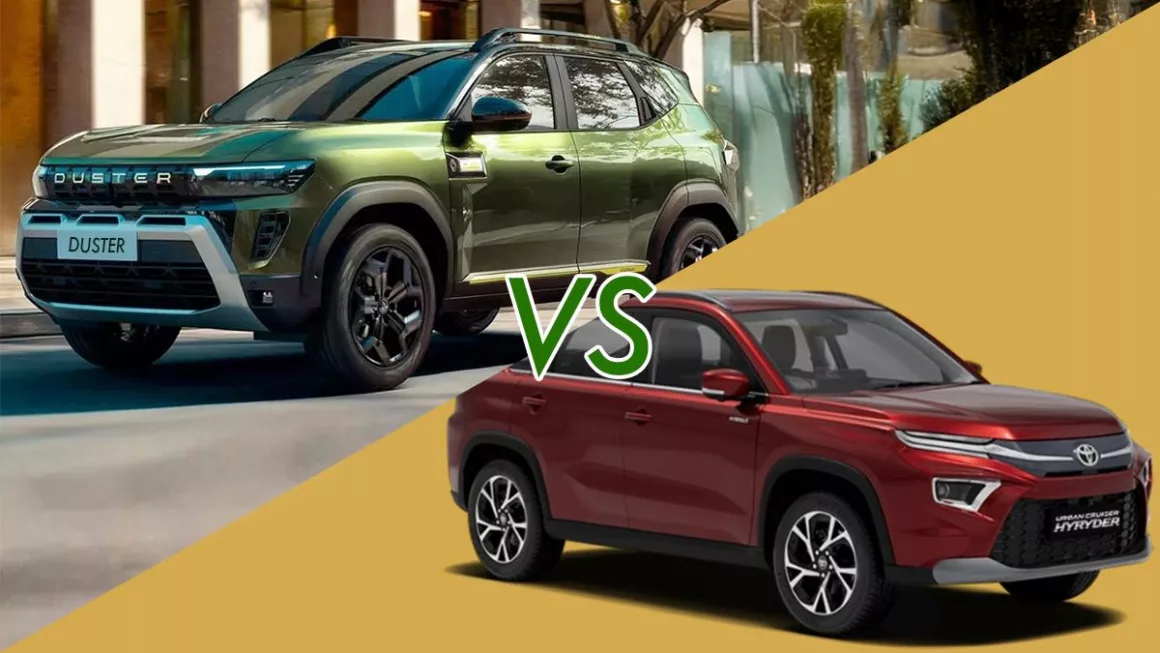
The return of the Renault Duster has heated the competition in the mid-size SUV segment. The new Renault Duster carries the same charisma that made its first-gen model a runaway success; however, it also embodies an economical character, thanks to its strong hybrid powertrain. While the combination of a driver’s car – Renault Duster and a strong-hybrid powertrain has taken the market by surprise, it has made the Duster a comparable model to the Toyota Urban Cruiser Hyryder, which is equipped with Toyota’s strong hybrid unit. Here is a comparison of the Renault Duster and Toyota Hyryder that not only compares their strong hybrid powertrains but also covers all other key aspects, so you can decide which to buy.
Renault Duster vs Toyota Urban Cruiser Hyryder: Dimensions & Design
| Renault Duster | Toyota Urban Cruiser Hyryder | |
| Length | 4,343 mm | 4,365 mm |
| Width | 1,813 mm | 1,795 mm |
| Height | 1,659 mm | 1,645 mm |
| Wheelbase | 2,657 mm | 2,600 mm |
| Ground Clearance | 212 mm | 210 mm |
| Boot Space | 518 litres | 373 litres (mild-hybrid), 265 litres (CNG) |
The Toyota Hyryder is 22 mm longer than the Renault Duster. Whereas the Duster is 18 mm wider, 14 mm taller, and has a 57 mm longer wheelbase, and significantly larger boot space compared to the Hyryder. Even though the space inside the cabins of these two SUVs is more or less the same, the Duster offers better headroom to the rear seat passengers. Speaking of the rear seat, both SUVs’ rear seats are best-suited for two adults and one child or teenager.
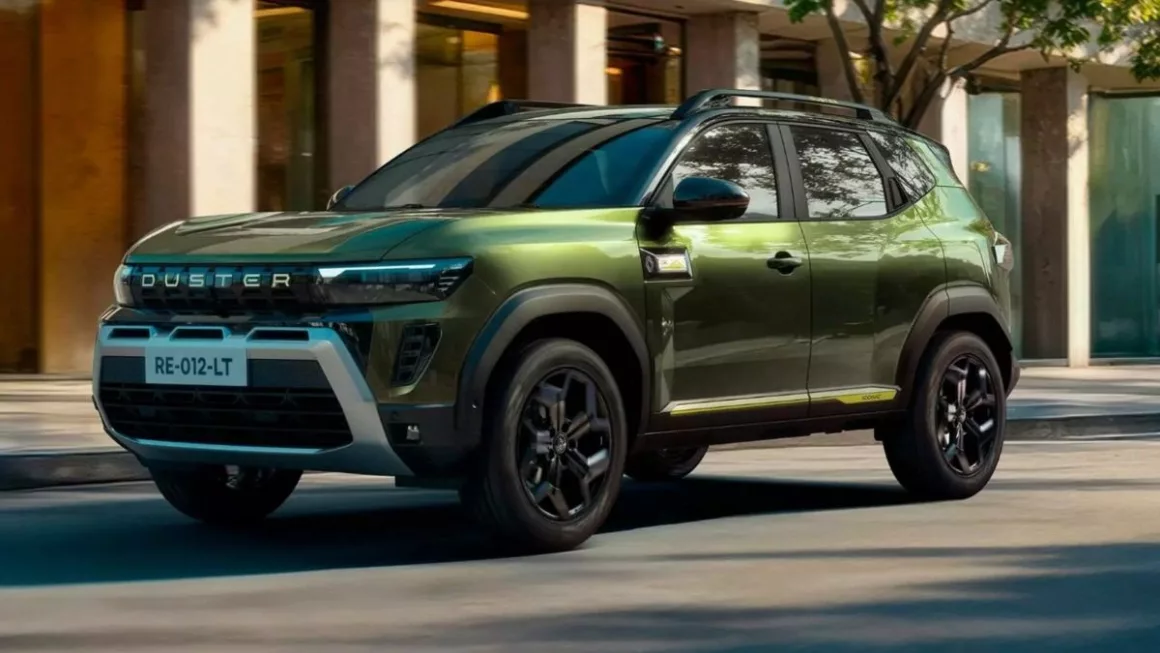
Road presence of the Renault Duster and Toyota Hyryder is vastly different from each other. The Duster looks more flamboyant, muscular, and sportier. Its bold face is defined by a bold gloss black grille section adorned by ‘DUSTER’ lettering, a couple of sporty scoops on the bonnet, rectangular headlamp units with eyebrow-like DRLs, functional air ducts tucked along the sides, an aggressive blacked-out bumper with silver housing, and a silver skid plate. The side profile highlights muscular hunches over the angular wheel arches that house 18-inch alloy wheels (larger than 17-inch alloys of the Hyryder), black roof rails, gloss black A, B, and C-pillars, and distinctive C-pillar-mounted rear door handles. At the rear, the Duster features a light bar connecting quirky arrow-shaped tail lamps, and the dual-tone bumper with silver housing.

Compared to the Duster, the Hyryder appeals as a simpler and more family-friendly SUV. Up front, the Hyryder gets an upright bumper, an oversized black air dam with a honeycomb pattern, and a gloss black grille panel with carbon fibre finish. The grille is adorned by a couple of chrome bars that split the twin DRLs, and the main LED headlamps on the bumpers have chrome surrounds too. The side profile is rather clean, but the squared-off wheel arches, black cladding covering the SUV’s bottom, and prominent shoulder lines add some rugged elements. At the rear, the Hyryder features slim wraparound C-shaped tail lamps connected by a thick chrome bar, vertically stacked reflectors, and a rather upright dual-tone bumper.
The Renault Duster is slightly larger than the Toyota Urban Cruiser Hyryder. As far as design is concerned, the Renault Duster looks bolder and sportier than the Hyryder, while the Hyryder looks more family-friendly.
Renault Duster vs Toyota Urban Cruiser Hyryder: Engine & Transmission
| Renault Duster | Toyota Urban Cruiser Hyryder | |
| Engine | 1-litre litre turbo petrol engine 1.3 litre turbo petrol engine 1.8-litre strong hybrid engine | 1.5-litre Mild Hybrid petrol 1.5-litre Strong Hybrid Petrol |
| Power | 100 PS (1-litre turbo) 163 PS (1.3-litre turbo) 160 PS (strong hybrid) | 103 PS (mild hybrid) 88 PS (CNG) 116 PS (strong hybrid) |
| Torque | 160 Nm (1-litre turbo) 280 Nm (1.-litre turbo) 172 Nm (strong hybrid) | 139 Nm (mild hybrid) 121.5 Nm (CNG) 141 Nm (strong hybrid) |
| Transmission | 6-speed manual with 1-litre turbo and 1.3-litre turbo engines 6-speed DCT automatic with 1.3-litre turbo engine DHT with a strong hybrid engine | 5-speed manual mild hybrid, CNG variants, and all-wheel-drive variants 6-speed torque converter automatic with mild hybrid e-CVT with strong hybrid |
| Mileage | Up to 21.11 km/l (mild hybrid) Up to 26.6 km/kg (CNG) Up to 27.97 km/l (strong hybrid) |
The engine and transmission options are the most defining characteristics of the characters of these two SUVs. Being the soul-sibling of the Maruti Grand Vitara, the Toyota Hyryder embodies the economical and smooth-running character. The Hyryder’s entry-level 1.5-litre 4-cylinder mild-hybrid engine is its best-selling engine. Tuned for absolute refinement, this engine delivers smooth drives and fantastic mileage figures, which are the key draws of the Hyryder. Compared to this engine, the Duster’s entry-level 1-litre turbo petrol engine is marginally weaker and is not as refined, given it is a 3-cylinder unit. Moreover, while the Hyryder’s mild-hybrid engine is available with both manual and automatic transmission, the Duster’s 1-litre turbo petrol engine is only available with a manual transmission. Another key advantage of the Hyryder is the availability of CNG variants and all-wheel-drive variants, which can be great for those residing in hilly areas.
When it comes to the strong hybrid units, the Duster is far superior to the Hyryder. The Duster’s strong hybrid unit has a 1.8-litre 4-cylinder petrol engine connected with a 49 PS-producing electric motor and a 20 PS-producing hybrid starter generator (HSG), powered by a 1.4kWh (280 V) battery. This entire hybrid unit churns out 160 PS power and 172 Nm peak torque.
Whereas, the Hyryder’s strong hybrid unit consists of a 1.5-litre 3-cylinder petrol engine connected with front-axle mounted electric motor, powered by a 0.76 kWh battery pack. This hybrid unit produces 116 PS power and 141 Nm peak torque.
Not only does the Duster Hybrid unit use a larger battery pack and a larger engine than those of the Hyryder’s hybrid unit, but it also comes with a better DHT automatic transmission, which offers a more conventional driving experience than the Hyryder’s e-CVT automatic. Moreover, a larger battery pack for the hybrid unit means better mileage figures. Renault claims that the Duster’s strong hybrid powertrain can do 80 percent of the city driving in EV mode. All the same, it is worth noting that the Duster’s hybrid powertrain will launch around Diwali 2026.
Another big advantage of the Duster is its 1.3-litre turbo petrol engine. It is the segment’s most powerful engine, and along with the Duster’s illustrious driving dynamics, it makes the French SUV the most entertaining car to drive in its segment.
In terms of ride comfort, while the Hyryder’s ride quality is comfortable enough, the Duster offers the segment-leading ride comfort and handling.
Among the powertrains, the Hyryder offers a better entry-level engine and the option of CNG powertrains and an all-wheel-drive setup. Whereas the Duster offers the advantages of the segment’s most powerful engine, a more entertaining driving experience, and better ride comfort.
Renault Duster vs Toyota Urban Cruiser Hyryder: Features & Comfort
| Renault Duster | Toyota Urban Cruiser Hyryder | |
| Infotainment system | 10.1-inch touchscreen infotainment system | 9-inch touchscreen infotainment system |
| Music system | 6-speaker Arkamys sound system | 6-speaker Arkamys sound system |
| Climate control | Dual-zone Automatic | Automatic |
| Ventilated seats | Front ventilated seats | Front ventilated seats |
| Adjustable steering | Tilt and Telescopic adjust | Tilt and Telescopic adjust |
| Drive modes | Available | Terrain Modes – Snow, Sport, Lock, Auto (all-wheel drive only) Drive modes: ECO + Normal + Power (Strong hybrid only) |
| Instrument cluster | 10.25-inch digital instrument cluster | 7-inch digital instrument cluster |
| Sunroof | Panoramic sunroof | Panoramic sunroof |
| Adjustable seats (manual or electric) | 6-way powered driver and front passenger seats | 8-way powered driver seat |
| Rear AC vents | Available | Available |
| 60:40 rear seat split | Available | Available |
| Cruise control | Available | Available |
On the inside, both Renault Duster and Toyota Hyryder meet the upmarket standards of the segment. However, they differ in the overall ambience. The Hyryder’s interior looks simpler and is high on functionality. The layered design of the dashboard adds a tastefulness, while the free-standing trapezoidal touchscreen is easy-to-read. Adding to the driver’s convenience is the traditional three-spoke steering, tactile buttons for most controls and functions, and a big chunky gear lever to hold.
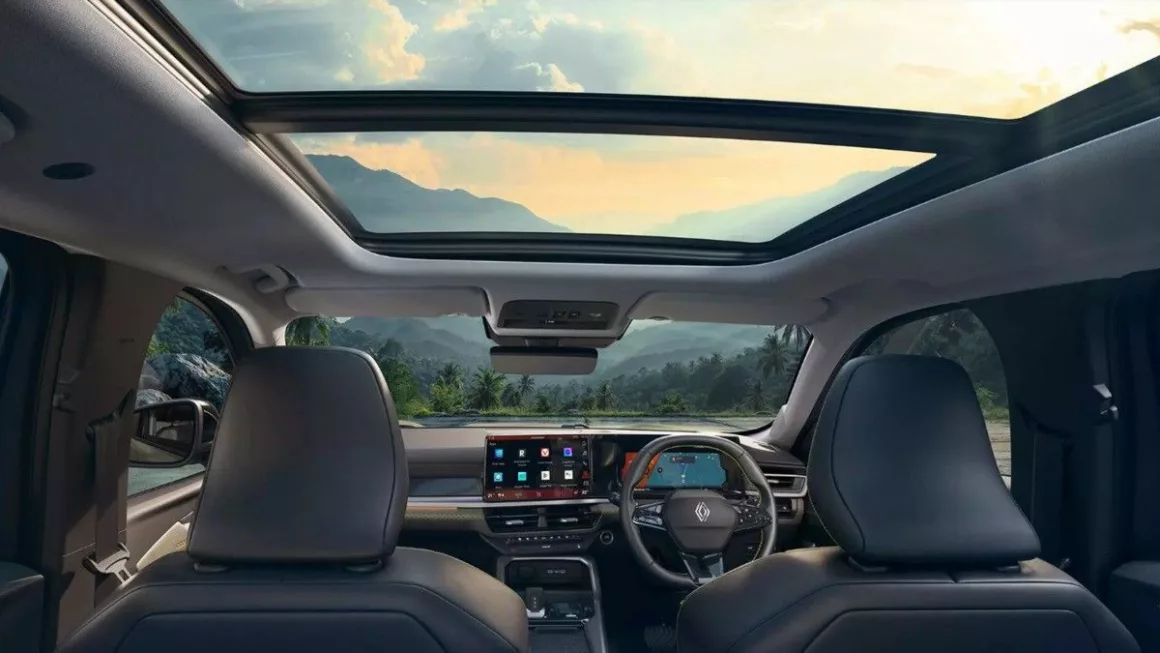
On the other hand, the Duster packs a sportier interior layout. Lending a sporty feel is chunky, squarish steering, a carbon fibre finish on the dashboard, stitching on the seats’ borders, and the advanced digital instrument cluster with commendable graphics. The touchscreen infotainment and centre console are angled to face the driver’s seat, for the ease of his operations.
In terms of upmarket features, both Duster and Hyryder pack ample modern-day amenities, such as a wireless charger, a powered driver seat, ventilated front seats, a panoramic sunroof, and others. However, the Duster pack a few more upmarket features than the Hyryder, for example, a front passenger seat and a powered tail gate, while the Hyryder offers the advantage of the head-up display.
On the inside, both Toyota Hyryder and Renault Duster are premium enough; however, the Duster’s interior layout is sportier.
Renault Duster vs Toyota Urban Cruiser Hyryder: Safety Features
| Renault Duster | Toyota Urban Cruiser Hyryder | |
| NCAP Safety Rating | Not tested | Not tested |
| Airbags | Six | Six |
| ABS with EBD | Yes | Yes |
| ESC | Yes | Yes |
| Traction Control | Yes | Yes |
| Automatic headlamps | Yes | Yes |
| Rain-sensing Wipers | Yes | Yes |
| Hill hold assist | Yes | Yes |
| Hill descent control | No | Yes (AWD only) |
| Rear sensors | Yes | Yes |
| Rear parking camera | 360-degree camera | 360-degree camera |
| ISOFIX Child seat anchor points | Yes | Yes |
| ADAS | Level-2 ADAS features | Not available |
Neither of these two SUVs has been tested by any NCAP, so no comments can be made about their structural strength. However, Renault claims that they will have the Duster tested, and it is certain to bag a full 5-star rating. Meanwhile, both Duster and Hyryder pack more than enough safety features, although the Duster is at an advantage of offering a Level-2 ADAS safety suite.
Renault Duster vs Toyota Urban Cruiser Hyryder: Price comparison
| Renault Duster | Toyota Urban Cruiser Hyryder | |
| Base variants (Ex-Showroom) | TBA | Rs 10.99 – 13.77 lakh |
| Mid variants (Ex-Showroom) | TBA | Rs 14.23 – 18.48 lakh |
| Upper mid variants (Ex-Showroom) | TBA | Rs 16.72 – 18.64 lakh |
| Top variant | TBA | Rs 19.76 – 19.99 lakh |
While the price of the Renault Duster has not been announced yet, it is expected to be priced at Rs. 10 – 20 lakh (ex-showroom). For these prices, the Duster will offer a better value than the Hyryder.
Renault Duster vs Toyota Urban Cruiser Hyryder: Which one should you buy
In most departments, the Renault Duster proves to be a better SUV than the Toyota Hyryder. The Duster offers a more stylish road presence, a more powerful engine, a stronger hybrid unit, more space in its cabin, more features, more entertaining driving performance, and significantly better ride comfort. So, the Duster should be a better car for you if you want all those perks. Another key point to remember is that Renault will offer a new Duster with a class-best 7-year/1,50,000km standard warranty.
All the same, the Hyryder is one of the best-selling SUVs for a reason. It offers the well-acclaimed Toyota reliability, a refined set of engines that deliver great mileage, and especially a potent entry-level engine. If these factors are high on your priority list, then you should buy a Toyota Hyryder.
Renault Duster vs Toyota Urban Cruiser Hyryder: FAQs
Which is larger, the Renault Duster or the Toyota Urban Cruiser Hyryder?
Renault Duster is 4,343 mm long, 1,813 mm wide, 1,659 mm tall, and has a wheelbase of 2,657 mm. The Toyota Urban Cruiser Hyryder is 4,365 mm long, 1,795 mm wide, 1,645 mm tall, and has a wheelbase of 2,600 mm. So, the Toyota Hyryder is 22 mm longer than the Renault Duster. Whereas the Duster is 18 mm wider, 14 mm taller, and has a 57 mm longer wheelbase compared to the Hyryder.
Among the Renault Duster and Toyota Urban Cruiser Hyryder, which SUV delivers better mileage?
The mileage figures of the Renault Duster have not been revealed yet; however, its strong hybrid powertrain is expected to deliver better mileage than the strong-hybrid powertrain of the Toyota Hyryder, which is 27.97 km/l.
Between the Renault Duster and Toyota Urban Cruiser Hyryder, which one offers a better ride quality?
The Renault Duster offers a better ride quality than the Toyota Urban Cruiser Hyryder
What types of automatic transmission systems are available in the Renault Duster and the Toyota Urban Cruiser Hyryder?
The Toyota Urban Cruiser Hyryder offers a 6-speed torque converter automatic and e-CVT automatic, while the Renault Duster offers a 6-speed DCT automatic and a DHT automatic (strong hybrid).