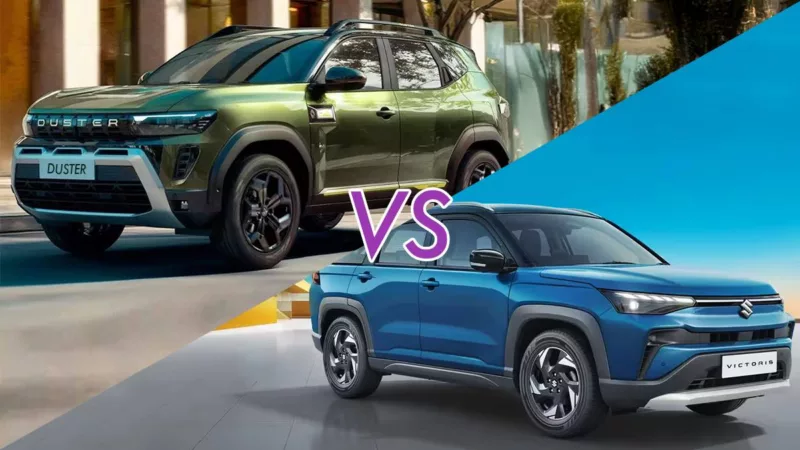
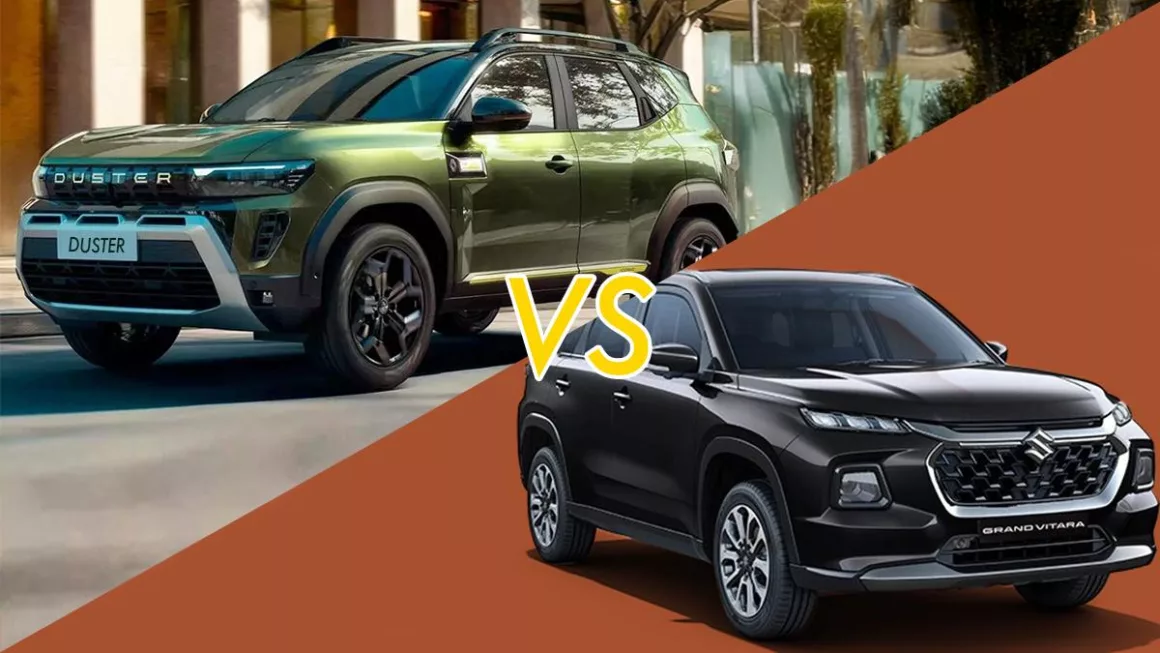
When it comes to the mid-size SUV segment, the Maruti Suzuki Grand Vitara is among the frontrunners. In typical Maruti fashion, the Grand Vitara offers economical car ownership, dependability and longevity. While the Grand Vitara has many rivals to compete against, recently, one more strong challenger has entered the segment – the Renault Duster. Now, even though the Grand Vitara is a family-friendly mid-size SUV mainly bought for its economic character and the Renault Duster is mainly recognised as a driver’s SUV, they can be worthy alternatives for each other, as both offer strong-hybrid powertrains. Further in this article on Renault Duster vs Maruti Suzuki Grand Vitara, we break down the key differences between the two so that you can decide which is better for your needs.
Renault Duster vs Maruti Suzuki Grand Vitara: Dimensions & Design
| Renault Duster | Maruti Suzuki Grand Vitara | |
| Length | 4,343 mm | 4,345 mm |
| Width | 1,813 mm | 1,795 mm |
| Height | 1,659 mm | 1,645 mm |
| Wheelbase | 2,657 mm | 2,600 mm |
| Ground Clearance | 212 mm | 210 mm |
| Boot Space | 518 litres | 373 litres (mild-hybrid), 265 litres (CNG) |
While the Maruti Grand Vitara is 2 mm longer than the Renault Duster, the Duster is 18 mm wider, 14 mm taller, and has a 57 mm longer wheelbase compared to the Grand Vitara. Limited headroom in the rear seat has always been one of the drawbacks of the Grand Vitara, while the Duster offers decent headroom for rear passengers. However, as far as rear seat space is concerned, in both SUVs, it is best suited for two adults and one child or teenager. It is worth mentioning that the Renault Duster offers a significantly larger boot than the Grand Vitara.

In terms of design, the Maruti Grand Vitara is a rather simpler and calmer-looking SUV than the Renault Duster. Up front, the Maruti SUV gets the block-like nose with a flat bonnet and a two-part grille that blends a thick chrome bar with a chromed hexagonal lower section with gloss-black chequered pattern. There are triple-pod LED DRLs at the bonnet’s edges, while the main headlamps sit lower down on the chiselled bumper. Over to the side, the Grand Vitara features prominent shoulder lines, squared-off wheel arches housing 17-inch alloy wheels (smaller than Duster’s 18-inch alloys), and a sloping roofline towards the rear. At the rear, the Grand Vitara gets a slightly raked windshield, a dual-tone bumper with aluminium finish, and connected taillights.
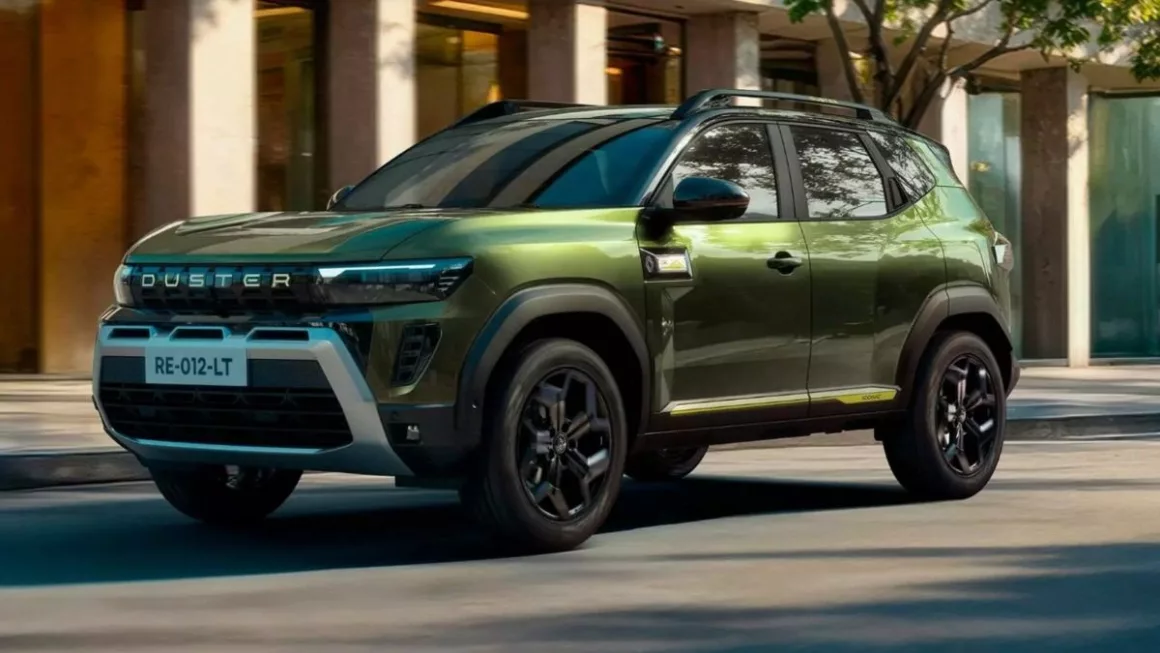
Compared to the Grand Vitara, the Renault Duster looks bolder and more fashionable. Its macho face features a large black bumper with a protruding silver surround, a bold gloss-black grille section with ‘DUSTER’ lettering embossed on it. There are deep scoops on the bonnet, boxy LED headlamps with eyebrow-shaped LED DRLs over them, and functional airducts neatly tucked on the sides. The side profile highlights muscular bulges over the angular wheel arches, rugged black cladding covering the SUV’s bottom, and the C-pillar-mounted rear door handles. At the rear, the French SUV gets distinctive arrow-shaped taillamps connected by a light bar, a sporty spoiler, and dual tone bumper with a silver surround.
The Renault Duster is larger than the Maruti Grand Vitara and offers better headroom to the rear seat passengers. As far as the road presence goes, the Grand Vitara looks calmer compared to the Duster, while the Duster looks more aggressive and sportier.
Renault Duster vs Maruti Suzuki Grand Vitara: Engine & Transmission
| Renault Duster | Maruti Suzuki Grand Vitara | |
| Engine | 1-litre litre turbo petrol engine 1.3 litre turbo petrol engine 1.8-litre strong hybrid engine | 1.5-litre Mild Hybrid petrol 1.5-litre Strong Hybrid Petrol |
| Power | 100 PS (1-litre turbo) 163 PS (1.3-litre turbo) 160 PS (strong hybrid) | 103 PS (mild hybrid) 88 PS (CNG) 116 PS (strong hybrid) |
| Torque | 160 Nm (1-litre turbo) 280 Nm (1.-litre turbo) 172 Nm (strong hybrid) | 139 Nm (mild hybrid) 121.5 Nm (CNG) 141 Nm (strong hybrid) |
| Transmission | 6-speed manual with 1-litre turbo and 1.3-litre turbo engines 6-speed DCT automatic with 1.3-litre turbo engine DHT with a strong hybrid engine | 5-speed manual mild hybrid, CNG variants, and all-wheel-drive variants 6-speed torque converter automatic with mild hybrid e-CVT with strong hybrid |
| Mileage | Up to 21.11 km/l (mild hybrid) Up to 26.6 km/kg (CNG) Up to 27.97 km/l (strong hybrid) |
The powertrains of these two SUVs are aligned with their purposes. The Maruti Grand Vitara is built for smooth, family-friendly drives; therefore, it is equipped with powertrains that produce decent levels of power to deliver a refined drive. Its best-selling engine is its entry-level 1.5-litre mild-hybrid engine. While this engine cannot be called peppy by any stretch of imagination, it is impressively refined and delivers pocket-friendly mileage figures. Speaking of mileage, the Grand Vitara’s best mileage comes from its strong-hybrid powertrain, which makes it one of the most fuel-efficient cars in India.
Compared to the Duster’s entry-level 1-litre 3-cylinder turbo petrol engine, the Grand Vitara’s 1.5-litre mild-hybrid petrol engine is marginally more powerful and a lot smoother. Another advantage of the Grand Vitara’s mild-hybrid engine is that it is also available with a smooth 6-speed torque converter automatic, while the Duster’s 1-litre turbo petrol engine is available with only a manual transmission.
The Grand Vitara also offers CNG-powered variants and an all-wheel-drive setup, which can be quite helpful for those living in hilly areas.
All the same, when it comes to the strong-hybrid powertrain, the Duster has a massive edge over the Maruti Grand Vitara. You see, the Duster’s strong hybrid powertrain consists of a 1.8-litre 4-cylinder petrol engine linked with a 49 PS-producing electric motor and a 20 PS-producing hybrid starter generator (HSG), powered by a 1.4kWh (280 V) battery. This entire setup produces 160 PS power and 172 Nm peak torque.
In comparison, the Grand Vitara’s strong hybrid powertrain is a 1.5-litre 3-cylinder petrol engine connected with front-axle mounted electric motor, powered by a 0.76 kWh battery pack. It has a total output of 116 PS power and 141 Nm peak torque.
The Duster’s strong hybrid setup uses a larger battery than that of the Grand Vitara’s strong hybrid unit; therefore, the Duster’s hybrid variants are expected to deliver higher mileage figures. Moreover, Renault claims that the Duster’s strong hybrid powertrain can do 80 percent of the city driving in EV mode. A key point to note is that the Duster’s hybrid variants will launch around Diwali 2026.
Another advantage of the Duster over the Grand Vitara is its 1.3-litre turbo petrol engine, which makes the Duster the most powerful car in the segment. Complemented by the Duster’s legendary driving dynamics, this engine will deliver an enthralling driving experience.
In terms of ride comfort, while the Grand Vitara offers a decent ride quality, the Duster is the gold standard for ride and handling balance and offers excellent ride comfort.
Among the powertrains, the Grand Vitara offers the advantages of a better entry-level engine, CNG variants, and an all-wheel-drive setup. Whereas the Duster offers the advantages of the segment’s most powerful engine, a more entertaining driving experience, and better ride comfort.
Renault Duster vs Maruti Suzuki Grand Vitara: Features & Comfort
| Renault Duster | Maruti Suzuki Grand Vitara | |
| Infotainment system | 10.1-inch touchscreen infotainment system | 9-inch touchscreen infotainment system |
| Music system | 6-speaker Arkamys sound system | 6-speaker Arkamys sound system |
| Climate control | Dual-zone Automatic | Automatic |
| Ventilated seats | Front ventilated seats | Front ventilated seats |
| Adjustable steering | Tilt and Telescopic adjust | Tilt and Telescopic adjust |
| Drive modes | Available | Terrain Modes – Snow, Sport, Lock, Auto (all-wheel drive only) Drive modes: ECO + Normal + Power (Strong hybrid only) |
| Instrument cluster | 10.25-inch digital instrument cluster | 7-inch digital instrument cluster |
| Sunroof | Panoramic sunroof | Panoramic sunroof |
| Adjustable seats (manual or electric) | 6-way powered driver and front passenger seats | 8-way powered driver seat |
| Rear AC vents | Available | Available |
| 60:40 rear seat split | Available | Available |
| Cruise control | Available | Available |
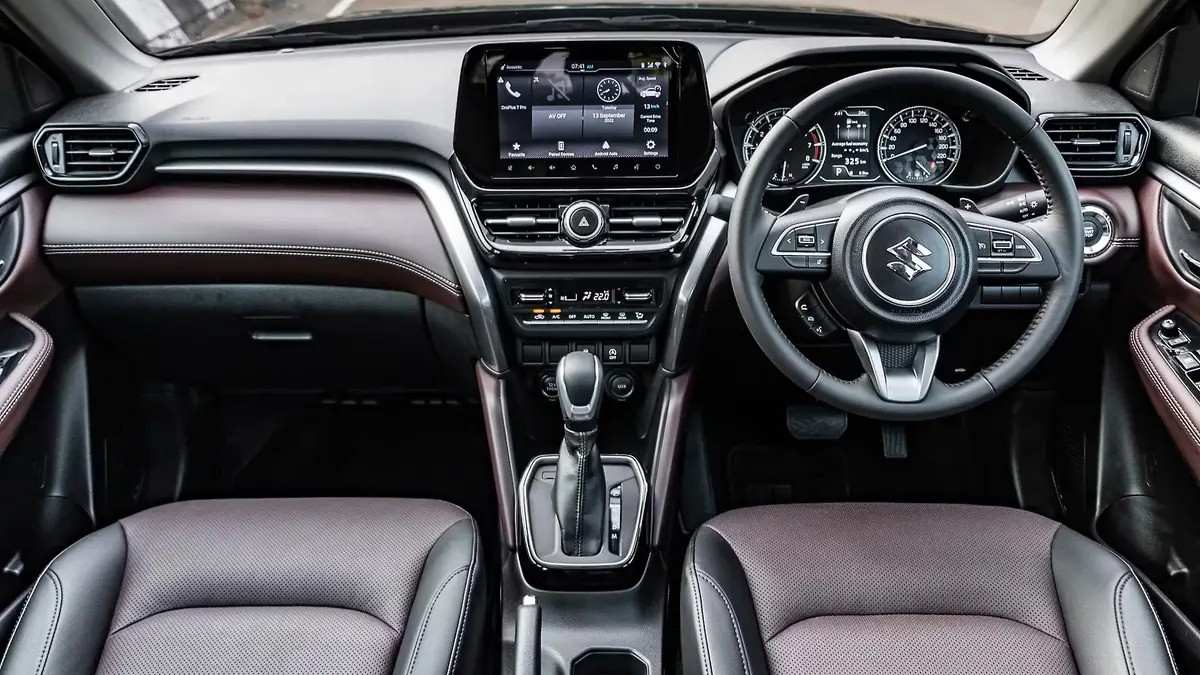
Like the exterior, the interiors of these two SUVs are quite expressive of their purposes. The Grand Vitara features traditional and functional interior elements to maximise the convenience of the passengers. For example, the free-standing touchscreen on the layered dashboard is easy to read, there is a traditional triple-spoke circular steering wheel, which most Indians are accustomed to, there are easy-to-operate physical buttons and knobs for most controls, and a big gear lever to hold. The overall layout of interiors is simple and practical.
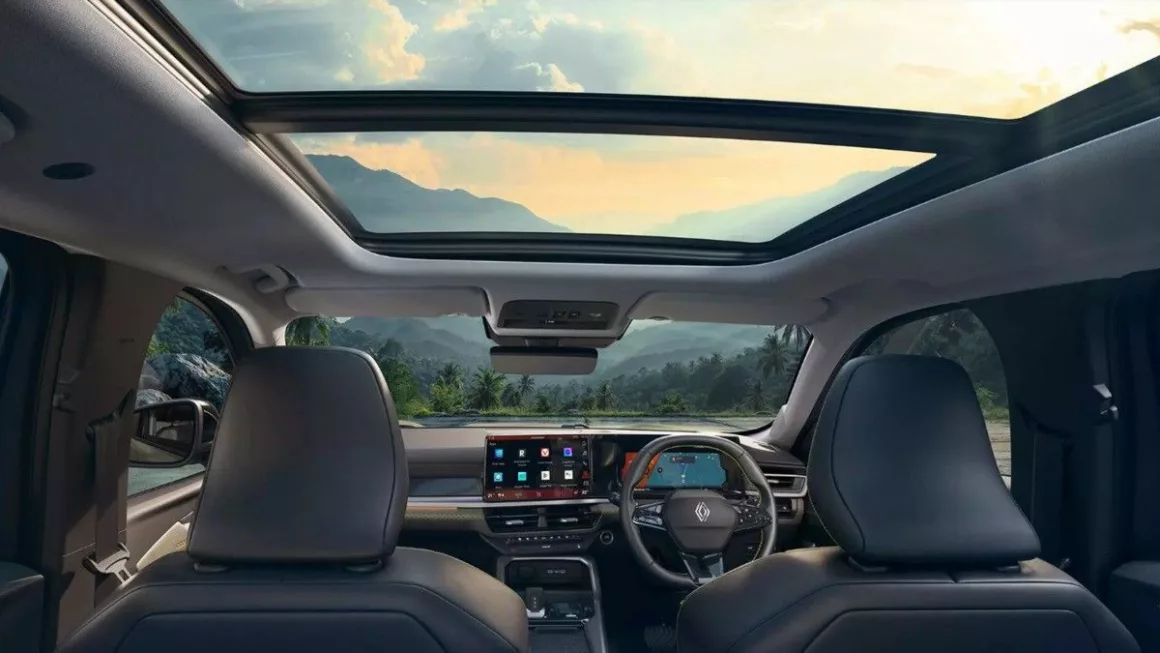
On the other hand, the Duster packs a sportier-looking interior. To ease operations for the driver, the touchscreen and centre console are slightly angled towards the driver’s seat. The sporty, squarish steering is chunky for a firm grip. The digital instrument cluster is advanced and has impressive graphics. There is a sporty carbon-fibre finish on the dashboard, and stitching at the borders of the seats.
Both Duster and Grand Vitara pack many modern-day amenities, such as ventilated front seats, a wireless charger, a powered driver seat, a 360-degree camera, wireless charger, and more. However, the Duster offers a few more upmarket features than the Grand Vitara; these include a powered front passenger seat and a powered tail gate, while the Grand Vitara offers the advantage of the head-up display.
On the inside, while both the Maruti Grand Vitara and the Renault Duster look and feel premium enough, the Duster feels sportier and more stylish.
Renault Duster vs Maruti Suzuki Grand Vitara: Safety Features
| Renault Duster | Maruti Suzuki Grand Vitara | |
| NCAP Safety Rating | Not tested | Not tested |
| Airbags | Six | Six |
| ABS with EBD | Yes | Yes |
| ESC | Yes | Yes |
| Traction Control | Yes | Yes |
| Automatic headlamps | Yes | Yes |
| Rain-sensing Wipers | Yes | Yes |
| Hill hold assist | Yes | Yes |
| Hill descent control | No | Yes (AWD only) |
| Rear sensors | Yes | Yes |
| Rear parking camera | 360-degree camera | 360-degree camera |
| ISOFIX Child seat anchor points | Yes | Yes |
| ADAS | Level-2 ADAS features | Not available |
Neither the Maruti Grand Vitara nor the Renault Duster has been tested by any NCAP. However, Renault claims that the new Duster is certain to bag a full 5-star rating in the NCAP safety test. As far as safety features are concerned, both Grand Vitara and Duster are well-equipped; however, the Duster has a massive advantage of offering a Level-2 ADAS safety suite.
Renault Duster vs Maruti Suzuki Grand Vitara: Price comparison
| Renault Duster | Maruti Suzuki Grand Vitara | |
| Base variants (Ex-Showroom) | TBA | Rs 10.77 – 13.45 lakh |
| Mid variants (Ex-Showroom) | TBA | Rs 13.70 – 18.73 lakh |
| Upper mid variants (Ex-Showroom) | TBA | Rs 16.63 – 18.50 lakh |
| Top variant | TBA | Rs 19.50 – 19.72 lakh |
The Renault Duster will launch in March 2026 and is expected to be priced at Rs. 10 – 20 lakh (ex-showroom). Since, in comparison to the Grand Vitara, the Duster offers slightly more space, more features, and more powerful engines, the Duster will be a better value-for-money offering in this price bracket.
Renault Duster vs Maruti Suzuki Grand Vitara: Which one should you buy
Renault has built a peach of a car in the form of the new Renault Duster. It looks attractive, offers a host of features, and is sure to deliver the driving fun that made it a blockbuster in the first place. While the Duster is more of a driver’s car, the new Duster can easily double up as a nice family SUV, especially considering its segment-leading ride comfort. So, if you want an SUV that is excellent to drive as well as a great family car, the Duster will comfortably meet all your needs.
All the same, the Grand Vitara comes with the unparalleled brand value of Maruti Suzuki, which also facilitates a great resale value. Although beyond the value aspect, the Grand Vitara is a family-friendly SUV that is certain to keep your pocket happy with its fantastic mileage and cheap maintenance costs. So, if you want an SUV that offers an economic ownership experience, go for the Grand Vitara. This stands most true for the entry-level and mid variants of the Grand Vitara that come equipped with a mild-hybrid engine, as the equation between the strong-hybrid powertrains of the Renault Duster and Grand Vitara will only be sorted when the Duster’s strong-hybrid variant launches around Diwali 2026.
Renault Duster vs Maruti Suzuki Grand Vitara: FAQs
Which is larger, the Renault Duster or the Maruti Suzuki Grand Vitara?
Renault Duster is 4,343 mm long, 1,813 mm wide, 1,659 mm tall, and has a wheelbase of 2,657 mm. The Maruti Suzuki Grand Vitara is 4,345 mm long, 1,795 mm wide, 1,645 mm tall, and has a wheelbase of 2,600 mm. While the Maruti Grand Vitara is 2 mm longer than the Renault Duster, the Duster is 18 mm wider, 14 mm taller, and has a 57 mm longer wheelbase compared to the Grand Vitara. Moreover, the Duster’s 518-litre boot space is significantly larger than the 373-litre boot space of the Grand Vitara.
Among the Renault Duster and Maruti Suzuki Grand Vitara, which SUV delivers better mileage?
The mileage figures of the Renault Duster have not been revealed yet; however, its strong hybrid powertrain is expected to deliver better mileage than the strong-hybrid powertrain of the Maruti Grand Vitara, which is 27.97 km/l.
Between the Renault Duster and Maruti Suzuki Grand Vitara, which one offers a better ride quality?
The Renault Duster offers a better ride quality than the Maruti Suzuki Grand Vitara
What types of automatic transmission systems are available in the Renault Duster and the Maruti Suzuki Grand Vitara?
The Maruti Suzuki Grand Vitara offers a 6-speed torque converter automatic and e-CVT automatic, while the Renault Duster offers a 6-speed DCT automatic and a DHT automatic (strong hybrid).