




The launch of the Tata Harrier EV marks a new dawn in the history of EVs in India, with Tata offering a package that blends unmatched performance, superior capabilities, top-notch features and mind-blowing practicality. Elevating the appeal of the ever-popular Tata Harrier, the Harrier EV comes as an exceptional product that has everything it takes to not only rule the EV segment but also give tough competition to ICE best-sellers like the Mahindra XUV700. Launched back in 2021, the XUV700 has since then been one of India’s most loved mid-size SUVs, offering a package that has a little something for every need, much like the Tata Harrier. With booking officially commencing from 2nd July 2025, it would be interesting to see how the Harrier EV competes against the XUV700. So here’s the in-depth comparison of the Tata Harrier EV vs the Mahindra XUV700.
Tata Harrier EV vs Mahindra XUV700: Dimensions
| Car | Tata Harrier EV | Mahindra XUV700 |
| Length | 4607 mm | 4695 mm |
| Width | 2132 mm | 1890 mm |
| Height | 1740 mm | 1755 mm |
| Wheelbase | 2741 mm | 2750 mm |
| Boot Space | 502 litres | 240 litres (All rows up) 450 litres (Third Row Down) |
| Ground Clearance | 205 mm | 200 mm |
As far as dimensions go, the comparison above shows that both SUVs largely stand shoulder to shoulder, but with a few differences setting them apart. The overall choice ultimately comes down to personal preferences since both SUVs offer a rather distinctive look and feel.
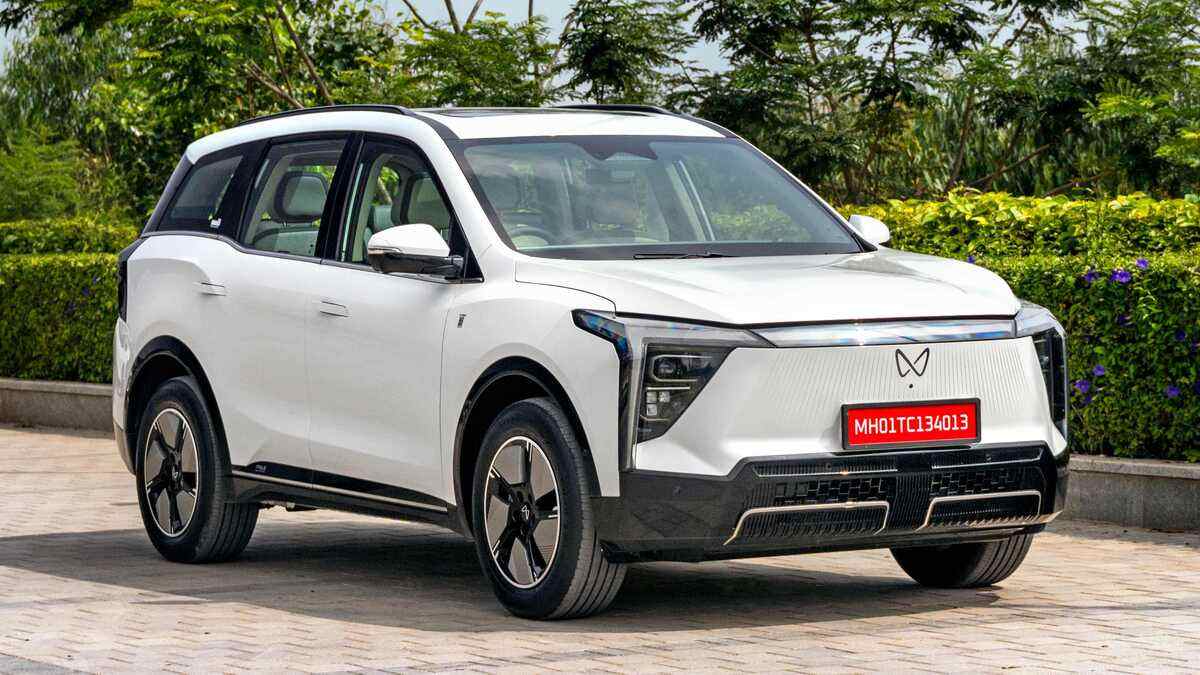
Comparing the two sizable SUVs, the XUV700 is 88 mm longer and 15 mm taller, with a 9 mm longer wheelbase. While the differences are all too minor to notice in real life, when parked adjacent to one another, one thing that you would not fail to notice is the Harrier’s width, which is about 242 mm more than what the XUV700 offers. This additional width gives the Harrier EV a much more dominant road presence.
Talking about in-cabin space and comfort, both SUVs offer ample head, leg and shoulder room for both front and rear passengers alike. In terms of bootspace, the Harrier EV, being a 5-seater, offer a substantially larger boot with 502 litres of storage capacity that is good enough for all your luggage needs. The XUV700, on the other hand, comes in either a 6 or 7 seater avatar with 240 litres of boot space with the third row up. While this might not be adequate for the entire family’s luggage, it is decent enough to store a few bags. In terms of overall appearance, while the XUV700 offers a great blend of sportiness and elegance, the Harrier EV does it well with its contemporary yet dominating stance, adorned with EV-specific elements upfront.
While both SUVs with their monocoque chassis offer a well-proportioned bodyline with great in-cabin space and comfort, the Harrier comes across as a great package for smaller families with additional boot space for added practicality. The XUV700, on the other hand, comes across as the go-to option for those looking to bring home a spacious and comfortable SUV that can seat up to 7 passengers. The final choice, therefore, comes down to the buyer’s preference.
Tata Harrier EV vs Mahindra XUV700: Engine and Transmission
Tata Harrier EV vs Mahindra XUV700: Petrol Engine Comparison | |||
Cars | Tata Harrier EV | Mahindra XUV700 | |
Engine/Battery Pack | 75 kWh with Dual-Motor Setup and Quad Wheel Drive (4x4) | 65 kWh with Single Motor Setup (4x2) | 2-litre Turbo Petrol |
Power | 158 PS (Front Motor) 238 PS (Rear Motor) | 238 PS | 200 PS |
Torque | 504 NM | Not Yet Revealed | 380 Nm |
Transmission (Manual) | N/A | 6-Speed Manual | |
Transmission (Automatic) | Single Speed Automatic | 6-speed Automatic | |
Mileage (Manual) | N/A | 15 kmpl | |
Mileage (Automatic) | Range of up to 622 km on a single charge (75 kWh) | 13 kmpl | |
With the Harrier EV’s electric powertrain going up against the XUV700’s petrol engine, the comparison is as exciting as it gets. In terms of raw specifications, what powers the XUV700 petrol is a 2-litre turbocharged unit, while on the other hand, the Harrier EV comes powered by either a 65 kWh battery pack with a single motor setup or a larger 75 kWh battery pack with a dual motor quad-wheel drivetrain.
Comparing the two sizable SUVs head-on, while Tata has not yet revealed the range and torque figure of the smaller 65 kWh battery pack, in terms of power output, the Harrier’s single motor setup does produce 38 PS more power than what the XUV700 offers. Talking about the larger 75 kWh battery pack with a dual motor setup, the Harrier EV surely takes the win by offering a combined power of 390 PS compared to 200 PS offered by the XUV700. The torque on offer is also exceptional, with a combined output of 504 Nm, compared to 380 NM offered by the XUV700. Considering the fact that the XUV700 does not offer a 4×4 drivetrain with the petrol engine, the Harrier EV comes across as a true winner both in terms of power and torque, leaving the XUV700’s ICE engines miles behind.
But with that said, the XUV700 does offer exceptional driving dynamics and a punch of power with its petrol engine that is both power-packed and efficient, with a mileage of up to 15 km/l with the manual transmission and up to 13 km/l with the automatic. The Harrier EV, on the other hand, offers a claimed range of up to 622 km on a single charge, which is great considering the current EV scenario. However, refuelling is still far more convenient than charging, and the final decision truly depends on whether or not you prefer an EV.
Overall, as far as the petrol game is concerned, the Harrier EV’s larger 75 kWh battery pack offering a quad-wheel drive setup seems to be a better pick in terms of both power delivery and torque output when compared to the XUV700’s 2-litre turbo petrol engine. However, the real-world range of the Harrier EV is something that is yet to be seen. Moreover, since there is not much known about the base 65 kWh battery pack’s claimed range and torque output, the XUV700’s turbo petrol engine feels like a better match against the smaller battery pack.
Tata Harrier EV vs Mahindra XUV700: Diesel Engine Comparison | |||
Cars | Tata Harrier EV | Mahindra XUV700 | |
Engine | 75 kWh with Dual-Motor Setup and Quad Wheel Drive (4x4) | 65 kWh with Single Motor Setup (4x2) | 2.2-litre Diesel |
Power | 158 PS (Front Motor) 238 PS (Rear Motor) | 238 PS | 155 PS and 185 PS |
Torque | 504 Nm | Not Yet Revealed | 360 Nm (With 155 PS) Up to 450 Nm (With 185 PS) |
Transmission (Manual) | N/A | 6-Speed Manual | |
Transmission (Automatic) | Single-Speed Automatic | 6-speed Automatic | |
4 Wheel Drive | Yes (75 kWh) | Yes (AT Diesel) | |
Mileage (Manual) | N/A | Up to 17.5 kmpl | |
Mileage (Automatic) | Range of up to 622 km on a single charge (75 kWh) | Up to 15.5 kmpl | |
The diesel comparison is where things get spicier between the two SUVs, since this is where the XUV700 also brings in a capable 4×4 drivetrain on offer. In terms of raw specification, what powers the XUV700 in its diesel avatar is a 2.2-litre turbocharged diesel engine that is available in two states of tune to choose from. The Harrier EV, on the other hand, is offered with either a 65 kWh battery pack with a single motor setup or a larger 75 kWh battery pack with a dual motor quad-wheel drivetrain.
Once again, with torque figures and range not officially revealed by Tata for the smaller 65 kWh battery pack, it is too soon to comment on how the single-motor smaller battery pack compares with the XUV700’s 2.2-litre diesel engine.
The only real faceoff here in the diesel game is when the XUV700’s turbocharged diesel engine is pitched against the Harrier EV’s larger 75 kWh battery pack. In terms of technical specifications, the Harrier EV leaves the XUV700 miles behind with exceptional combined power and torque figures that are substantially better than what the XUV700 offers. For perspective, the XUV700’s 2.2-litre in its most capable state of tune produces a maximum of 185 PS of power, which is 205 PS less than the 390 PS of combined power output delivered by the Harrier EV’s 75 kWh battery pack. The same is the story in terms of torque output, where the Harrier EV’s combined output of 504 NM outshines the XUV700’s 450 NM of torque. With a range of up to 622 km on a single charge, the Harrier EV offers a mind-blowing price-to-performance ratio that is tough to match by the XUV700’s diesel engine.
Even in terms of 4×4 capabilities, the Harrier EV seems to take the edge with several off-road oriented features such as low-speed cruise control, 6 terrain modes, transparent mode that projects what is beneath the vehicle on the infotainment.
Overall, when it comes to the diesel engine and performance, it seems as if the larger 75 kWh battery pack of the Harrier EV enjoys quite an edge over the XUV700 with its dual motor quad-wheel drive setup, exceptional power and impressive torque output.
Tata Harrier EV vs Mahindra XUV700: Features and Comfort
| Tata Harrier EV | Mahindra XUV700 | |
| Infotainment system | 14.53-inch touch infotainment system with Android Auto and Apple CarPlay | 10.25-inch touch infotainment system with Android Auto and Apple CarPlay |
| Instrument Cluster | 12.25-inch digital instrument cluster | 10.25-inch digital instrument cluster |
| Music System | 10 Speaker Premium Audio by JBL | 12 Speaker Premium Audio by Sony |
| Climate Control | Yes, Dual Zone | Yes, Dual Zone |
| Ventilated Seats | Yes | No |
| Adjustable Steering | Yes | Yes |
| Sunroof | Yes, Panoramic | Yes, Panoramic |
| Adjustable Driver Seats | Yes, 6-way power adjustable driver’s seat with Memory Function | Yes, 6-way power adjustable driver’s seat |
| Adjustable Passenger Seats | Yes, 4-way power adjustable passenger seat | No |
| Cruise Control | Yes | Yes |
| Wireless Charger | Yes | Yes |
| Type C Charging Sockets | Yes | Yes |
| Paddle Shifters | Yes | No |
| 540 Degree Camera | Yes | No, Only 360 Degree |
| Powered Tailgate | Yes | No |
| Cooled Under Armrest Storage | Yes | No |
| Automatic Parking | Yes | No |
The head-on comparison above proves why both the Tata Harrier EV as well as the XUV700 are two of the most popular choices in the SUV segment. Both cars come well equipped with several premium features such as a panoramic sunroof, touch infotainment system, cruise control, climate control and much more.
However, when pitched head-on, the recently launched Tata Harrier EV gets a slight edge over the XUV700 with some of the latest features, such as:
- A bigger 14.53-inch segment-first QLED infotainment system
- A bigger 12.25-inch instrument cluster
- A 4-way powered passenger seat
- A 6-way powered driver seat with memory function
- Cooled Under-Armrest Storage
- 540-degree camera
- Automatic Parallel Parking
- Forward and backwards summoning
Overall, both SUVs stand head to head when it comes to features, with the Tata Harrier EV enjoying a slight edge over the XUV700 with a few more goodies up its sleeve.
Tata Harrier EV vs Mahindra XUV700: Safety Features
| Tata Harrier EV | Mahindra XUV700 | |
| GNCAP Safety Rating | 5-star | 5-Star |
| Airbags | Up to 7 | Up to 7 |
| ABS with EBD | Yes | Yes |
| ESC | Yes | Yes |
| Traction Control | Yes | Yes |
| Hill Hold Control | Yes | Yes |
| Hill Descent Control | Yes | Yes |
| Rear and Front Parking Sensors | Yes | Yes |
| ISOFIX | Yes | Yes |
| Front and Rear Disc Brakes | Yes, with Disc Wiping | Yes |
| TPMS | Yes | Yes |
| Level 2 ADAS | Yes | Yes |
| Digital Video Recorder (Dashcam and Rear Camera) | Yes | No |
When it comes to safety, both the Tata Harrier EV as well as the Mahindra XUV700 are a class apart. With both SUVs scoring a perfect 5-star safety rating, safety is something that is very well taken care of by both SUVs.
With almost all modern-day safety features onboard, both SUVs truly impress. But with that said, when compared head-on, the Tata Harrier EV does have an edge over the XUV700 with a few additional features such as a 540-degree camera, digital video recorder, disc wiping, etc.
Tata Harrier EV vs Mahindra XUV700: Price Comparison
| Variant | Tata Harrier EV Price Ex-Showroom | Mahindra XUV700Price Ex-Showroom |
| Base Variant | Rs. 21.49 lakh | Rs. 14.49 lakh |
| Mid Variant | Rs. 23 to 25 lakh (Estimated) | Rs. 16.89 – 19.24 lakh |
| Upper Mid Variant | Rs. 26 to 28 lakh (Estimated) | Rs. 19.49 – 22.04 lakh |
| Top Variant | Rs. 29.50 to 32.50 lakh (Estimated) | Rs. 22.24 – 25.14 lakh |
When it comes to the price comparison, the Tata Harrier EV comes with a three-trim lineup that includes Adventure, Fearless and Empowered. On the other hand, the Mahindra XUV700’s variant lineup is spread across 5 trims, including the MX, AX5 Select, AX5, AX7, and AX7 Luxury, which are spread across 30 variants.
Talking about the XUV700, what impresses prospective buyers the most is the trim diversity that Mahindra has offered with the XUV700. With a plethora of trims to choose from, the XUV700 offers a carefully curated package that has a little something for every need. With prices starting at Rs. 14.49 Lakh, the XUV700 in its base trim is about Rs. 7 Lakh cheaper than the Harrier EV. Whether or not this jump is truly justified is something that will be revealed once Tata releases more details about the Harrier EV’s trim lineup and inclusions. However, considering that Tata is offering a lifetime unlimited kilometre warranty with the Harrier EV, the SUV’s overall value quotient is already quite strong.
New Tata Harrier EV vs Mahindra XUV700: Summary
Be it the Tata Harrier EV or the Mahindra XUV700, both SUVs offer a highly impressive package that offers everything that one might look for in an SUV. While the Mahindra XUV700 comes as a formidable option in the ICE space, the Harrier EV is a newcomer ready to bring an evolution in the EV segment.
While in terms of dimension, the choice is more or less based on body preferences and style, when it comes to the powertrain, the Harrier EV offers two highly capable battery pack options, with the larger one offering a quad-wheel drive for the first time in the history of Tata after the Safari Storme. With a claimed range of up to 622 km on a single charge, the larger battery pack is truly a force to reckon with, while the smaller pack’s worthiness is yet to be seen. The XUV700, on the other hand, offers two capable turbo petrol and diesel engine options with both manual and automatic transmission as an option, along with a 4×4 drivetrain as well. In terms of onboard features and safety, both SUVs offer nothing but the best, with the Harrier EV having a few more cards up its sleeve.